Rapid responders: How new tools and technologies are helping to improve motor sport medicine
The final seminar of FIA Safety Week 2026 looked at how research, regulations and regular training are making medical response to racing incidents even better
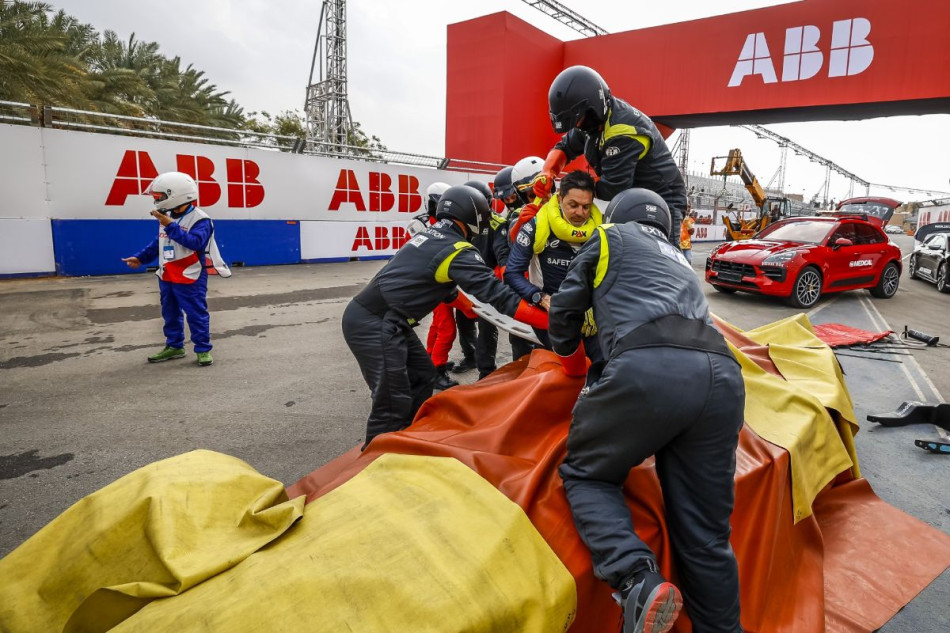
FIA Safety Week 2026 closed with an extensive medical seminar in which FIA medical experts discussed a wide range of topics including improved extrication methods, dealing with incidents in new series and the evolving demands of Formula 1 in a new era of regulation.
In a significant update to the methods used to extract a driver in single seater categories, FIA medical and rescue teams will no longer extract a driver in their seat. Reflecting the emergence of pre-hospital immediate care as a specialty, the medical priority of rescue teams has evolved, and driver seat extraction also includes some considerable drawbacks. The introduction of the HANS system and forward impact protection HALO device has made seat extrication more complex and less necessary, as there are quicker and more suitable ways to extract a driver.
From this season, drivers who are uninjured or able to get out of the car unaided may do so even in the event of high g-force accidents due to the advanced safety measures that have now been implemented. This may be done under the supervision of the attending medical staff and with their guidance if needed.
Boa and Short Board extraction methods will be implemented in situations of potential injuries to protect the driver. The commercially available Boa device is a snake-like padded device with grab handles on the ends. The device is passed around the neck of the driver (who may be wearing a c-collar) and under the arms to allow the driver to be lifted from above and behind. The device pulls tight enough under traction to stabilise the upper spine while not impeding respiration and can assist with a rapid, controlled extrication out of the vehicle.
Meanwhile, the short-board extraction method involves the insert of a board behind the driver in the seat. The driver is strapped quickly to the device around the chest and head with lifting handles on the device to allow quick and safe guided extraction of the driver from the seat and onto a board or vacuum mattress.
Finally, if the driver is facing an immediate danger to life, such as a significant vehicle fire, a hazardous situation or a major injury requiring immediate treatment, rescuers may use the grab handles on the racing suit while managing c-spine inline stabilisation to remove the driver from the vehicle rapidly.
The medical seminar also included a discussion around the use of C-collars in motor sport incidents with Dr László Hetzman, an air ambulance physician with pre-hospital qualification who works in F1, F2 and F3, pointing to growing evidence that the use of C-collar for the stabilisation of neck and spine in the aftermath of incidents should be reconsidered.
“The collar is not really doing the job it was meant to, because it was meant to prevent secondary damage, but there’s also a lot of case studies out now proving that actually applying the C-collar may worsen the injury itself,” he said. “There are a lot of studies on when we apply the collar, we actually do a lot of extra movements, so that’s also not helping.”
Dr Hetzman advocated for the use of other methods of stabilisation including straps and padded blocks at the side and back of the head.
“The suggested approach for the future would be this: during the extrication, whatever technique you use you will need to provide manual in-line stabilisation anyway. Even in the past while using the C-collar, you had to do this because we know that the collar itself is not enough protection. So basically, don’t change anything, just lose the collar and do good quality manual in-line stabilisation while you’re taking the driver out of the car.”
Dr Sean Petherbridge, President of the FIA Medical Commission thanked Dt Hetzman for the presentation saying: “We must always be evidence-based and ahead of the game when it comes to our clinical practice. So, we’ll take this to the Medical Commission and present the evidence and hopefully a jury of our peers will agree that it’s time for change based on evidence.”
The session then moved on to Formula 1 and a presentation from F1 Medical Delegate Dr Pedro Esteban on the demands of motor sport’s top category.
He pointed to the development of F1’s new power unit – in which electric power increases by 300% – as a potential source of difficulty but added that “happily, no changes will be necessary.”
“We have a new MGU-K, kinetic motor generator unit, and it moves from 120 kilowatts to 350 —almost three times more. That means that the energy provided by the combustion engine and the electric one will be 50/50, when previously it was 20 for the electric and 80% for the combustion engine,” he said.
“The ERS will be enclosed within the safety cell, within the chassis, and all high voltage will keep the same colour—orange. And as far as it could be within the safety cell, that means the car is safer,” he added. “The good news is there is no change for the first responders. They still need to wear the gloves, and the boots. They need to neutralise the car if needed. Remember, we have the lights, and we have the information immediately from the technical delegate if the car is safe or unsafe. And in race control I will provide this information immediately to the CMO but although the power unit has changed, there is no change for the first responder on scene.”
He also raised the issue of access from the track to the medical centre, with improvement needed at some circuits and added that visits to designated hospitals will be carried out in the coming year.
The final part of the seminar saw Dr Anna Carreras deliver an overview of the nutrition and health demands placed on competitors, while Dr Cem Boneval looked at the particular demands of the FIA World Rally Championship, an arena in which “approach times are a lot longer”.
“In circuit it is around two minutes – very fast,” he said. “The approach time in rallies, we target the approach time of 10 minutes, which is sometimes really hard to achieve.”
He also pointed to a need for more targeted tools for rally cars, more terrain-specific rescue vehicles and a need for rescue car drivers with more experience of driving in the extreme conditions often encountered on rallies.
 Facebook
 Twitter