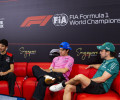
F1 - 2026 Singapore Grand Prix - Friday Press Conference Transcript

TEAM REPRESENTATIVES - Alan PERMANE (Racing Bulls), Zak BROWN (McLaren), Toto WOLFF (Mercedes)
Q: Toto, if we could start with you, please. Let's begin with upgrades. They proved frustrating last time out at Sepang. Kimi is continuing to use them here. What did you learn? Did you learn any more about them in FP1?
Toto WOLFF: Good afternoon, everyone. The complication is that we've brought a big upgrade to Baku, and Baku is so tricky and a little bit of an outlier in terms of the temperatures that we've seen on Friday and Saturday, and with the tarmac being broken, or the tarmac being quite open, that we kind of didn't know whether the upgrade wasn't working as we thought or whether it was influenced indeed by the track conditions. And that's why we decided to go to Singapore, have two different specs of cars and see what it’s going to do, well knowing that Singapore is an outlier of a track too. So, we've done that exercise in FP1. There is a pattern, but most importantly is to really dissect what's working and what's not on the old and the new spec and then finding a way forward, picking the best bits and seeing where the development direction needs to get us in order to extract the optimum lap time. Now, having said that, obviously running two different cars is not always ideal, but it's a compromise we just need to take. So, we have two test pilots at the moment. We need to take it in order to assure that we're doing the right thing for next year as well.
Q: You say there's a pattern. Is the pattern similar to what you were seeing at Sepang?
TW: Yeah, there is a similar pattern, that the new car seems to be a little more tricky to drive. Not saying it's necessarily slower, because there will be goodness in it, but maybe we haven't just found a way of putting it all together and tuning it. The older car is a bit more stable, grippy, but that is really just one data point. That is one free practice session, and it will be needing more time to really come to more conclusive information.
Q: And with the 2027 car beginning to take shape back in the factory, how crucial is it to find a way forward with this upgrade?
TW: Very. I mean, we've put a few months of upgrades into the car, clearly pointing in a direction that we think is advantageous, and maybe we just need to calibrate it a little bit in order to find the right way forward for 2027.
Q: OK, quick word on drivers now. There's been some speculation in the media about some of the decisions that have been made between your two drivers this year. What would you say to those people who feel that the team has favoured Kimi at times?
TW: They're brainless, whoever thinks that. I mean, it's completely nonsensical. We've had it in the past with Lewis fans. I mean, literally, I don't know what's going on. Do they think I have a button that says, "George engine failure now", or disadvantaging one driver against the other when we are fighting for a Constructors' Championship, when we have always had the mindset of providing everybody equal material? But I guess this is maybe where social media goes today. People hide behind their screens and then they lash out. There's a lot of polarisation going on, and sometimes I read what people write. I find it hilarious. These people really contribute to my own entertainment when they are abusing the team or myself. I'm Satan, I've heard. So, yeah, overall funny.
Zak BROWN: Silver Arrows rules will fix it. I’ve got a book I can share with you.
TW: Yeah. You obviously… You have the exclusive rights on fruits, Papaya Rules, so we need to come up with something better. But really zero understanding and respect for people who come up with these things. They should, rather than watching Formula 1, they should do Teletubbies or some Mickey Mouse.
Q: All right, Toto, thank you for that. Zak, if we could come to you now. The last couple of races have been difficult for the team. With seven races to go, look, what's the target between now and the end of 2026?
ZB: The target is to come into every race weekend with a chance to win. We look better here in Free Practice 1. We feel more on top of things than we have the last couple of races, and then, of course, won a couple of races prior to that. So, I think it shows how competitive the sport is and how quickly the top four teams, and the whole grid for that matter, everyone's kind of moving around in levels of competitiveness. But our goal is to try and come to each race weekend and win, but that's easier said than done.
Q: And when you look at the final standings, if, for example, you finish in the top three, how would you rate your season?
ZB: Difficult. A lot of progress, lots of learning. Again, I think if you go to Australia, everyone thought Merc's going to win 24 races on the trot, and they've had an unbelievable season. I'd be very surprised if they didn't win the championship. But knowing them as I do, that's not going to be the attitude any race team has, right? It's not over until it's over. But now you've got four teams that have won races. I think you have four teams that can come into this weekend and win. And so here we are again with an unbelievably competitive Formula 1. You've had Alpine with a pole, and when you look at the timing screens, whether it's a Racing Bulls or an Alpine, no one's far away. So, it's getting closer and closer. So, this has been a tough year, a learning year, but I want to finish on a high note so we can go into '27 fighting for the championship.
Q: What about the drivers? In here yesterday, Lando was talking about the way he's driven, how pleased he is with some of the performances he's put in. How have you seen him kick on as a world champion?
ZB: He's just getting better and better. Very confident. You can see when we have a bad day at the office, his approach to the next session is like a world champion. He shrugs it off quickly. I think we've all seen at times he can be too critical of himself over the years, and now I think he's got that world champion confidence where it's like, "Well, let's get it next session." So I've not seen him ever drive this well, as is, but he's still the same Lando, which I think is great. So, he's changed on track in a world champion way, but he's still the Lando I think we all know and love off the track.
Q: What about Oscar? He seems to have struggled more with the car, got better in the last couple of races. Is he back to the Oscar you know?
ZB: Yeah, I think he is. And I think we've seen with these cars, it's kind of mixed up the field a little bit, right? Lewis is getting the better out of the Ferrari right now. George got more out of the car last year than Kimi. That's moved around. I think these cars are so complex. I think some have kind of adapted a little bit quicker than others, but I'm liking everything I see out of Oscar. I think he's feeling much more confident, on top of things. I like where both our drivers are now.
Q: OK, Zak, thank you for that. Alan, we'll come to you now. Can we start by talking about Arvid in FP1? First time he's been to this track in Singapore. Just how has he settled in with just that one practice session?
Alan PERMANE: Yeah, pretty well. I did the same trick with him here as I did in Montreal. New track, Sprint weekend. I just said to take the FP1, Sprint Qualifying and Sprint like FP1, FP2, FP3. So, no pressure. We don't expect you to be top 10 in FP1. And it seems to work, that approach. It definitely takes the pressure off him and just allows him to drive and get on with it. So, a very decent session. We didn't have the best car to start with this morning. Not this morning, is it? This evening, this afternoon, wherever we are. And had to make some changes to both cars in the middle of that session. So, we were running around quite close to the back for that first run on Hards. Made a decent change to both and figured out we had some issues. Much more comfortable then, and then onto the Mediums at the end, we looked to be in our normal sort of place.
Q: While we're talking drivers, most teams have confirmed their line-ups for 2027. VCARB hasn't. When can we expect news?
AP: I don't want to give you a definite date. You know, no, that's not going to work. It's going to be in the coming weeks, let's say. I mean, we're in no rush. I think everyone knows we've got two fantastic drivers. We've got a fantastic driver in F2 at the moment, and they're all there and ready to go. But three doesn't fit into two, of course, and we're just going to take a little bit more time and make sure we get the right pairing for next year.
Q: What's the key criteria for you?
AP: There's many, many, many things. I guess top of the list is speed and pace and all that goes with that. But there's lots, of course, in the background because we're in a slightly unique situation, I guess. We want to bring on young drivers, we want to bring on young talent, and of course we have one eye on them progressing in the future. So, it's not just about the here and now, it's also about what they can do in the future.
QUESTIONS FROM THE FLOOR
Q: (Nelson Valkenburg – Viaplay) I have a question for you, Toto and Zak. James Vowles has been quite active in pushing some changes for the cost cap, and he seems to be making some headway in terms of getting support in the paddock. Do you agree that the cost cap needs changes? And as top teams, do you agree with what he's proposing as a sliding scale based on points scored? Would you support it?
TW: Well, there are a few topics. The reason the cost cap came in was in order to balance the performances between small teams and bigger teams. We had to actually quite dramatically restructure, whilst other teams were below the cap and they were able to hire. So, I think that was the main idea. Now, where the cost cap has taken us is that obviously we have profitable entities, and that is, from a pure economic effect, nice. But it's also suppressing salaries. We were always an aspirational sport. We attracted the best talent from the best universities because of the possibilities you had in Formula 1. Now you can get someone into a Formula 1 team today on enthusiasm, but at a certain stage, when after five, six or seven years and you have a PhD, your salaries are still depressed versus a tech company or a hedge fund or investment banking, that becomes a problem. So, where we stand, I'd love to have a little bit more room in the cost cap for lower salaries, a bracket, rather than buying new front wings, but give the possibility of paying a little bit more and being attractive as a sport. Now, I'm not sure that many find this a good idea. Obviously, it also depends on the size of the team. I think we exchanged that is something we would like to do, but if you have the reality of the budget, a smaller team is not going to be happy about us having five million more in the cost cap to spend for PhDs. So that's the second point. The third point is that what James is alluding to is the CapEx allowance or the CapEx possibilities. Now, how the regs were changed was that rather than having this CapEx budget, your CapEx would go into operational costs, into OpEx. So, the consequence is the teams that spent a lot in the past on CapEx, like us, for example, have a huge amount of costs that we need to depreciate in the cost cap. The ones that haven't spent a lot obviously have much more possibility to spend on infrastructure or whatever you want to, what was CapEx before. So I think I have super sympathy with a team like Williams and with James, and he's super clever, but we just need to find the right balance of not undoing something that we actually consciously changed a year or two ago. So, yeah, it's just a forward-moving discussion. Personally, I don't like the concept of adjustment based on some positions. BoP for me is like a red mist. We're having these tiny little adjustments on aero time, ATR, which is almost invisible to the spectator and hasn't been a big thing because it's really tiny. We have the catch-up mechanisms on the power units. If someone were to fall behind dramatically, then you get that opportunity, but it wasn't a leapfrogging mechanism. So, the job that the FIA have done in that respect I think is very good. They haven't allowed any politics to creep in, people making noises that they wanted to do or not. I think they handled that very well. So, do we really want another mechanism where you're being allowed to have more CapEx, OpEx based on your championship position? I'm not sure.
ZB: Yeah, I think we do a good job as a sport of reviewing financial regulations, sporting regulations, technical regulations. And I think we all collectively work well together to always try and move forward. Sport is very complex. I think the biggest difference in racing teams are the people, the culture. I know we don't have the largest infrastructure in Formula 1. I don't think we have the second or third largest infrastructure in Formula 1. We've got a customer engine, all these things which you hear over the years you can't win a championship with, and we have. And I think that's because we're a really well-performing team of people. So always open-minded. I do think we made a step forward in combining the CapEx and the OpEx. So now you have a decision to make where to invest, just like you have a decision to make on what drivers you want to bring on board. So, I think it's complicated, always open-minded. But I think if you look last year, it was the closest grid in the history of Formula 1. And then when I was growing up racing, most of the time it was one or two teams winning. Now it's four. Fifth got a pole this year. So, I think the sport's extremely competitive as it is, but always open to any conversation.
TW: I think, can I add to this? You are a good example. McLaren is a very good example. A team that wasn't owned by a big mothership that had endless funding like some of us, but able to work yourself out of a situation that wasn't good, starting to win races two years ago and then finally winning a championship.
ZB: Two.
TW: Sorry, two, of course!
ZB: It was hard, so I don't want to forget the second one.
TW: Yeah, that was a hard one. Yeah. So, good example. And then when you look at the pecking order today, you have VCARB that is always there or thereabouts in the top 10, performing. You have Alpine, you've seen they made a big step forward, and then there are four of us bigger teams that, like Zak said, four of us have won races. So I think overall, as an organisation, and I know that James is carrying with him huge ballast with an old-school, old-style Formula 1 team with massive machine shops and lots of production and making it leaner and more efficient and convincing people that the structure in the future needs to be different is super difficult. But I don't think that the CapEx/OpEx is going to unleash much more potential, in my opinion, and not with an adjustment mechanism.
Q: (Craig Slater – Sky Sports) Question for Toto. Just picking up on what you said earlier, Toto. Clearly, it's ridiculous to talk about bias, but it's an old thought within Formula 1 that a team would naturally gravitate towards the driver delivering results, which obviously has been largely Kimi this year. How sensitive have you been as team boss to keep an eye on George's sort of psychology in that regard? And do these next two events, if you were to take a grid penalty in both, does it take the pressure off just a little bit to not have that direct comparison with Kimi? Do you sense this sort of regroup in that area?
TW: I've always tried, since I came into Formula 1, even in my Williams days, to be the most balanced and the most structured, transparent, sorry, the most balanced and most transparent with the drivers. I have told this story before. I remember being a complete rookie and running into Alain Prost on the grid of a race, and I said, "Just out of interest, why did it go so wrong between you and Senna?" And he said, "Because we never knew what the team was about. You felt that you were the flavour of the month one time, and then two months later you thought the politics were going against you. There were different situations where you had the feeling that you're really not wanted." So, I took it as my challenge to keep it always balanced. And it was not easy with Lewis and Nico back in the day. And that's why people can think what they want, but the integrity in that respect is something that's important for me, and the drivers know it. We have had Kimi since he was 11. He is an integral part of the team. It is very nice to see him grow, be in a position now that he is fighting for a championship at such a young age, the talent he has. And then on the other side, George, who has been with us since he was 17, someone that I feel a lot of, how can I say, emotions for and compassion. We are very close. We are spending time with Carmen and Susie off the track with each other. If people would see that we're travelling together, we're having coffee in the same coffee shop, we're going to the gym, that's why it's pretty annoying to have some lunatics that have no understanding really about how relationships work coming up with these kinds of accusations. So, I don't pay any attention to this. Most important is that George knows how the team is and Kimi knows, and we will always try to give them equal opportunity. And when it comes to the upgrade, it's a good example. We don't know which one is going to be quicker. And so you take a decision and say, "Let's try to find out." And there is no great political thinking behind it. And when it comes to racing, like the Papaya Rules, we have always been very clear that we're not standing in each other's way. We don't like the yo-yo racing that could cost a position if someone is close to us, and the quicker car, if it's behind, is always going to have an advantage. And that could go either direction, doesn't matter. Even if it is now that it's more realistic for Kimi to win a championship in sheer mathematical probability, we would still give George the same opportunities. And that's important. That's the ethos and the integrity on which the team has operated since 2013, since I came, and we are going to stick to that. And then people can think what they want.
Q: (Jon Noble – The Race) To Alan on the cost cap issue. Obviously Racing Bulls is a team outside of the top four and would in theory stand to benefit. Where do you stand on the debate and would you support the proposal if it goes to vote in the Commission?
AP: I think both these guys had really good points, especially Zak saying about how close things were last year. And that isn't by accident. And I think that's linked to some of the things that Toto said about the aero rules, the wind tunnel rules, the ATR stuff. It just allows a little tweak. And of course, as you have longer regulation cycles, the teams close up and drivers close up, and I think that's definitely something we want. I don't think we would support a wholesale change to the cost cap rules to start being able to spend huge amounts more money because I think it's served us very well for the, I don't know how many years we're into it now, six years we're into it now. I think it's served Formula 1 very, very well. And I think maybe there are tweaks to do, for sure. But as Toto said, if you want to spend a whole lot of money on CapEx, you can. The mechanism's in there. So if James wants to go and spend $100 million on something, he can do that. You just pay it off over the X number of years. So, the mechanism is already there.
Q: (Christian Menath – Motorsport-Magazin.com) Question for you, Toto. You touched on it earlier with the doubts on the upgrade and what it means for 2027. Do you think this has always been the biggest risk of your strategy this year, with having one big upgrade, that you have no recalibration of the system and that you need the clarity for the development route in '27?
TW: Yes, you have a point. I think that we are one of those large organisations that needs to be very careful how and when we spend our cost cap money. And we felt that the right strategic decision was to work towards a bigger one and then introduce it. Obviously, with the risk of if it doesn't work as you've anticipated, it's just quite difficult to dial yourself out and understand why it hasn't worked. So, it's something which we will look at in the future of saying maybe we'll do smaller steps, and then if there is a warning light saying, "OK", it's easier to undo. But there is no clear way at that stage because so far it has worked. I just remember 2022, which went well. We thought we had one and a half seconds we're putting on the car at the beginning of the season, and that backfired. But since then, this year particularly, every upgrade we brought on the car, remember Montreal was a big hit, a big hit in terms of it worked very well. So, if that didn't, why? That's the most important question. And if we come to conclusions that say this is what wasn't as expected, then we have to obviously think for the future.
Q: (Martin Moravecs – DPA) A question to Toto, please. You've been already talking about Nico and Lewis back then. At the end of the year, it will be 10 years ago that Nico was world champion and retired. How do you look back on this battle between Nico and Lewis, and how do you see him nowadays, Nico, as an entrepreneur or businessman?
TW: I'll start with the second one. There are not many Formula 1 drivers, other than Niki, who I know that have been able to kind of reinvent themselves in a totally different career. And I see Nico a lot. I respect him a lot. We are friends. He set up a venture capital fund that is one of the best performing. He is giving it 24/7. He is very hard-working. He is respected within the tech industry very much. I am happy to be invested there and associated, and you really need to take your hat off, seeing what he's been able to achieve in this very short time of 10 years since he's left the sport. So that's the current situation. Looking back at it, I wish I would have had the 10 years more experience than I have today, because there's a few things I would have handled differently and maybe avoided some of the controversy, particularly in the last race where we tried to micromanage a situation that didn't need to be managed, in my opinion. And that was my fault. So yes, 10 years. It's crazy how fast time runs. It feels like it's maybe five years ago, but we've moved on from that. My relationship and the team's relationship with Lewis is as strong as it can be whilst being rivals on track, and the same with Nico.
ENDS
 Facebook
 Twitter