
F1 - 2026 Belgian Grand Prix - Thursday Press Conference Transcript

PART ONE – Max VERSTAPPEN (Red Bull Racing), Alex ALBON (Williams), Esteban OCON (Haas)
Q: Max, if we could start with you, please. Back at Spa, one of your favourite tracks. From a performance point of view, what can we expect from you and Red Bull?
Max VERSTAPPEN: Yeah, I don’t know. Let’s see tomorrow, to be honest. I don’t know how we are going to perform. It’s as simple as that, to be honest.
Q: How do you assess the last two races, then? Austria seemed strong and Silverstone a little bit disappointing.
MV: Exactly like that, and that’s why I also don’t really know what to expect here. So, it’s better not to think about it too much and just go out.
Q: You’re reverting back to the old-spec rear wing. Can you explain the thinking behind that?
MV: I think it’s quite obvious, no? So, yeah, we’ll go back to the old one and then see whenever the latest, or new one, is ready again to be used for us.
Q: Let’s talk off track. There’s been yet more speculation about your future in recent days and recent weeks. Is there any update you can give us?
MV: No.
Q: And what do you make of the speculation?
MV: Nothing.
Q: And do you have a date in mind?
MV: Nope. There’s nothing to say from my side.
Q: So, full commitment to Red Bull in 2026?
MV: I said there’s nothing to say.
Q: Final one from me. You’ve announced that you’re going to work with McLaren young driver Dries Van Langendonck. What are you going to do for him, and how will you split roles with McLaren?
MV: He has been a big talent for a long time already in go-karting, and I think you can spot quite quickly when someone is a little bit more special than someone else. I think that has carried on with what he’s doing right now in Formula 4, and that’s why I think it’s just very exciting to try and help him and guide him, of course hand in hand with McLaren’s side as well, to make the right decisions for his future. He wants to get to Formula 1, and I’m just trying to make sure that will happen in the future. It’s honestly a very exciting project to be part of.
Q: Alex, let’s come to you. It’s been a bit of a tough run since scoring points in Monaco. What have been the biggest issues with the car?
Alex ALBON: Just a bit of everything, really. I think there’s not one specific trend that we’ve seen in the last two races. More than anything, other teams bring upgrades. We had a smaller one in Silverstone. It worked, but you also have to be honest: the gap to the other midfield cars is at such a point that the upgrades we’ve got on the car are bringing performance, but not enough to fight with them.
Q: Were you expecting more from the upgrade at Silverstone?
AA: No, I think they behaved as we expected. Obviously, we always want more because you want to close the gap, but actually it pretty much did what it said.
Q: When you think of the medium and longer term, do you have any concerns about the direction Williams is headed?
AA: No. We’re just behind in terms of where we started the year. We started our updates late. We must have brought fewer upgrades than the other teams around us, so it’s just going through that phase. We are in a rebuilding phase. We have a lot to do. There are a lot of changes happening at the factory as well, and in many ways it’s frustrating, but it’s patience. There’s a lot going on behind the scenes, and all for the good, but at the same time, unfortunately, it does feel like some of the upgrades and the processes take a little bit longer. In the meantime, we do have an upgrade for Baku. Whether or not that puts us fighting with the midfield, we’ll see, but it’s coming. It just feels like this whole year so far has been a little bit on the back foot.
Q: Alex, how much rests on the Baku upgrade in terms of future development?
AA: Not so much. I think the biggest thing for us is to be on weight. I think that’s been a big talking point for us, and we know that’s the goal of that upgrade for the most part. There are still some other areas. We know even on just pure downforce we’re not matching other teams as well, so we still need to work on that. At the same time, we are already transitioning quite early into next year’s car. We’re starting to do more and more simulator work on next year’s car. That’s not to say that we’ll leave this car behind, but we are thinking long-term as well, for the best of the team.
Q: Esteban, let’s come to you now. Can we start by looking back, because it’s 10 years since you made your Formula 1 debut here at Spa with Manor. What are your memories of that first weekend?
Esteban OCON: Yeah, crazy. Crazy to think it’s been 10 years. Time flies, really. I don’t feel like I’ve been in Formula 1 for 10 years. It feels like I’ve been here for a couple of years, not more. So, yeah, I’m excited about this weekend. Back then it was very different, of course. It was my debut. There was a lot to learn. I was racing with the faces I was always watching on TV: Fernando, Jenson, Räikkönen, all these guys. It was quite special. But, yeah, I did a good job because I’m here 10 years later, so it’s okay.
Q: What’s the biggest lesson you’ve learned in that decade?
EO: A lot of things, of course. I’m a very different driver than I was back then, but the motivation is still the same. The motivation is still to take the car that you have in your hands as far as it can go, as high as it can go, and I’m still motivated for as much as I can behind the wheel.
Q: It’s been a tough couple of races. Just bringing it on to 2026, what goals have you set yourself for this weekend?
EO: It’s been a tough couple of races as a team. Of course, we are chasing a bit of performance at the moment. We do have a little bit of new stuff coming this weekend as well. We need to find more performance. I think we extracted the maximum out of the car in Silverstone, which was quite positive, but of course it was not quite enough. After the start from even quite far back in the order, I went up to P11 and we could not hold the pace of the other midfield cars. This is what we need to work on. We know that, and we’re all focused on doing that, hopefully here or later when more parts come on the car.
QUESTIONS FROM THE FLOOR
Q: (Craig Slater – Sky Sports) Max, you’re clearly at the top of your game as a driver, at the pinnacle of the sport. The team is transitioning as an engine manufacturer and so on. How confident are you that they can give you the tools to operate where you belong, i.e. at the front, if not this year then next year? And are you concerned about the ongoing loss of engineering names, the latest being Michael Manning?
MV: We’re just looking to the future, trying to fix the current issues that we have on the car, but that’s a very open discussion. Sometimes you get a little bit disappointed or upset after a race, but, for example, after Silverstone you go home, you reset. On Wednesday, I was back at the factory and then you prepare again for the weekends ahead. That’s how we’ve been operating all the years together. Of course, some years you’re just a little bit more competitive than others, but in terms of my approach and how we work as a team, nothing really changes. People come and go. I think that’s sometimes also part of the process. Sometimes you want people to stay, potentially, yes, but I think that’s just how life is and how sport is as well. You just have to carry on and try to find new talent. That’s what you also look at all the time, and that’s what we do.
Q: (Mariana Becker – TV Globo) Hi, Max. Do you want to stay at Red Bull next year? Are you driving for Red Bull next year?
MV: Okay, I don’t want to go here and say yes and no, and this and that, about my future. I’ve said already many times that if there was something new, I would say it myself. Thank you.
Q: (David Croft – Sky Sports F1) Esteban, congratulations on 10 years as an F1 driver. I think you started 17th and finished 16th in your debut race here for Manor. It’s a team that probably didn’t have the funding it would have liked at the time. Are you driving for a team that has similar issues, not quite getting the funding that you or other members of the team would like? And is that one of the reasons you started well this year at Haas and are now lagging behind a little bit in the midfield?
EO: I don’t think so. I don’t think it’s fair to compare it to how it was at Manor back then. I think we were 4.5 or five seconds off the pace. If you look at last year, for example, the way we developed through the year and the way we brought the updates later in the year helped me to secure seventh place in Abu Dhabi, for example. So we managed to overcome these difficulties. This weekend, we have some new stuff on the car. We will have further updates later in the year, so the team is doing a good job providing new stuff on the car to keep tracking the performance and keep improving it. Of course, you always want more resources and more stuff, but that’s Ayao’s job, not ours. We need to tell him where we need more implication, more people, and where we are lacking stuff. That’s what we are doing with Ollie and the whole team together. But I’ve got trust in the team that hopefully we will not stay in that position and we will improve. We are doing a good job inside the team at the moment. There are good talking points, no hiding, everything is up to what we need for the future. We just need to make it happen.
Q: (Margot Laffite – Canal+) Hello, Max. We’re doing a feature around Laurent Mekies, one year since he stepped into Red Bull. Can you talk us through this first year alongside him?
MV: Yes, it’s been really good. I get on very well with Laurent. We speak a lot on track, but also off track. I think the relationship that he has within the team is great, and everything for me feels very positive. I think it’s always nice when you can discuss a lot of things with your team boss. So, from that sense, I’m very happy. It’s all very open and transparent.
Q: (Leonid Kliuev – GrandePremio.com.br) Max, loyalty became a talking point lately across many areas. It was also raised by Checo, for instance, in the podcast. What does loyalty mean to you? How does a driver show loyalty, in your view, to a team, and the other way around? What should teams do to express loyalty to drivers?
MV: It’s just the relationship that you build over all the years, the things that the team does for you and the things that you do for the team. That has always been tremendously good with Red Bull. Of course, from my side, it’s like a second family for me.
Q: (Cyprien Juilhard – Auto Hebdo) A question for the three of you. Lewis has said that he has reduced his time in the simulator and that it helped him to find performance in a different way. What are your thoughts on the simulator? Do you use it, and do you think that it’s helpful for you to find performance, or more for the team to learn new things and also find performance?
AA: It’s a hard one because it really depends on the correlation of the car to the simulator. I think the more you can trust the tyre model and the car physics, and the better correlated the team can get it, then you do trust it. But if you have doubts or question marks on it, it’s very hard to do setup items in a simulator and then totally commit yourself to those changes on the track. For now, especially personally speaking, a lot of the work is done on deployments and how you drive around these regulations and maximise your efficiency. Otherwise, yeah, I do understand where Lewis comes from.
EO: Yeah, I mean, rejoining Alex, at the moment for us we are doing a lot of work on the engine side of things, and I think that’s been really good. We have very good correlation between the engine on the real track and the engine on the simulator. We are struggling a bit more on the rest, on our side, but this is something that the team is working on. We do spend a lot of time with Ollie every week in the simulator, but more to get everything under control, to make sure that we have all the simulations done, the start, the practice start, whatever it can be. It’s still useful, but maybe less than where it was last year or the years before, I would say, on the chassis side especially.
MV: Well, you can look at it from two things. If you use it to try and set up the car and then it’s not correlating, of course it’s not ideal. But most of the time, I think it’s just trying to always make it better because, of course, in F1 there are so many rule changes that you’re constantly updating the product. I think that’s just the main thing with the team. You’re always trying to update the product, or there are upgrades coming to the car, or future ideas that you want to test on the simulator. Sometimes, as a driver, you feel like it’s not the most useful for yourself, but it’s very useful for the team. That’s why it’s very important that the simulator is used a lot. Of course, some days are quite boring, but I know that it’s part of the process and part of trying to make the team better, push ahead and improve the overall package of the car.
Q: (Luke Smith – The Athletic) Max, just one for you about your work with Dries that’s coming up. I know you’ve obviously got your sim racing team and the GT3 team as well. How much do you see that kind of thing as part of your long-term future, even beyond Formula 1, in terms of finding the next generation of talent and team ownership? Could that even extend into F1 one day, do you think?
MV: To F1, I don’t know, but for me it just needs to be exciting and promising, and that’s what I feel is happening now with Dries. Of course, the goal, like I said before, is Formula 1, so we’re just going to try and help him achieve that by making, hopefully, the right calls and decisions in terms of where he has to race, what he has to do, help him on the simulator side as well, and just try to give him more and more experience. He’s only 15, so there’s still a lot to learn naturally, but luckily, I think, in terms of raw speed, that’s there. From my side, of course, with the GT3 project and the future endurance races that I want to do myself, I want to involve the team in that as well. There are just a lot of exciting things ahead, probably. He’s very good for a 15-year-old. Compared to myself when I was 15, he’s very, very good at the same age.
Q: (Rodrigo França – Car Magazine Brazil) A question to the three of you, starting with Max, please. You’re all considered excellent drivers in the rain, but do you remember the first time you raced in wet conditions in go-karting? Were you already good, or did you really struggle in your first wet race?
MV: In Belgium and Holland, it rains a lot. Probably one of my first races was in the wet. Also, when I raced in minis, we had no wet tyres, so you had to race with slicks in the wet. It’s quite challenging, but very good, I think, for your control in the wet. I had already practised that since I was four and a half with my dad. We would be driving a lot in the wet anyway. He was showing me the lines. He was standing on the track at a certain place where I was almost hitting him as well, where he had to jump out of the way because I entered the corner a bit too quickly. But that’s how you learn. You have to go off. You have to understand where the grip is or isn’t. It’s a work in progress over all the years. You constantly learn something new, and especially at that young age you make bigger steps. Now, not so much, but when you’re five years old all the way until you’re 12, maybe even 14, you really make big steps in the wet and learn how to manage all these things.
AA: Yeah, same as Max. Holland, Belgium and the UK share the same fair weather, so I do remember a lot of karting as a kid. I do remember my first race. I don’t remember many things. I remember I wanted to just drift in the wet…
EO: You had wet tyres in the UK?
AA: Yeah, we had wet tyres.
EO: We were on slicks.
AA: Really? Maybe I was watching too much Fast & Furious as a kid. The final of the race was wet. It was at Rye House, and I was just trying to slide as much as I could. I don’t know why.
MV: I guess it went well?
AA: Yeah, not too bad, but I learned how to drive in the wet shortly after.
EO: Yeah, I remember driving in the wet. Sometimes it was even snow. I had these ski gloves where you could blow inside and get your hands warm again. I had to do three or four laps, then stop because my hands were blue. I was getting to a heater and getting close. I was in Rouen, also near the UK and Belgium, so it was freezing cold. But I probably did more laps in the wet when I was young than in the dry. I also remember a race with you, Max, in 2011 in WSK in Sarno. We were fighting in the wet.
MV: Yeah, I guess I spun that race.
EO: No, you did.
MV: Yeah, I remember that.
EO: I always enjoyed racing in the wet. Some years later, we met again with Max in the wet. I wish he was not there in 2024 so I could have won that race, but unfortunately he was there.
Q: (Andrew Benson – BBC Sport) Max, you’ve obviously developed a good relationship with Kimi Antonelli. When did you first become aware of him? What qualities did you see in him at the time, and what do you think has explained his great performances this year compared to last year?
MV: I think when he was still in go-karting, you could already see that he was one of the standout talents. Then, of course, you grow from the junior categories into the senior categories. What was also very impressive, and I always say that drivers should do this before they go to cars, is to at least do a few races in a shifter category to learn a bit how to use the gears, how to race and how to do starts. I think in his first race he immediately pulled it off between the big guns in go-karting. At that young age, you can see that raw talent, and then it just continued into cars. He also made quite a quick jump to Formula 1, and it’s normal that in your first year there are certain mistakes that you make. I think we all make them. Of course, when you’re driving for a top team, it’s always highlighted a little bit more. But for me, there was never a doubt that he would make a jump the year after and already be a lot more consistently competitive. It’s normal in the progression of a driver. In your rookie season it can be quite tough, but at the moment, of course, he’s doing an amazing job.
Q: (Luke Smith – The Athletic) Max, just to follow up on that, obviously you were 17 when you first got on the F1 grid. It’s a very young age to have such a spotlight placed on you. Kimi has gone through a lot of that at a very young age as well. How do you remember those first couple of years and adjusting to being in the spotlight so much?
MV: I guess in the first few years, because you didn’t really do a lot of car racing, you make some of the mistakes that you should normally be making in a lower category. You’re understanding car racing more, what you need from a car and what you want in terms of setup. I probably had that learning curve in Formula 1 in my first two seasons. I would say it was a big learning curve, but once you’re given the opportunity, you can’t say no. For me, it was the right thing to do. Of course, your learning curve is probably a bit bigger in the first two years, but I was happy to do so.
Q: (James Phillips – Motorsport Monday) A question for Alex. You’ve talked about the patience required for analysing the upgrades this year. Can you give us an insight into how the team is analysing them behind the scenes for the ones that have been delivered so far, particularly in light of how challenging Silverstone was?
AA: To give you an example, we turned our Sunday race into a bit of a test session with the front wing. We scan it and make sure the correlation is correct to the wind tunnel. Carlos and I were on the simulator on Tuesday and Wednesday, taking turns and making sure that we feel the same things in the simulator as we felt on the track. There are also meetings that we have with aero and with the whole team, really, going through the upgrade, what it felt like, and making sure that we’re all aligned on the next upgrade. Is it doing what we wanted? Are we going in the right direction? Is there anything additional that the drivers felt with that new front wing, for example, that we maybe didn’t expect? Did it have some unique characteristics that we like or don’t want? That’s it, really. I think it’s just very collaborative with us at Williams.
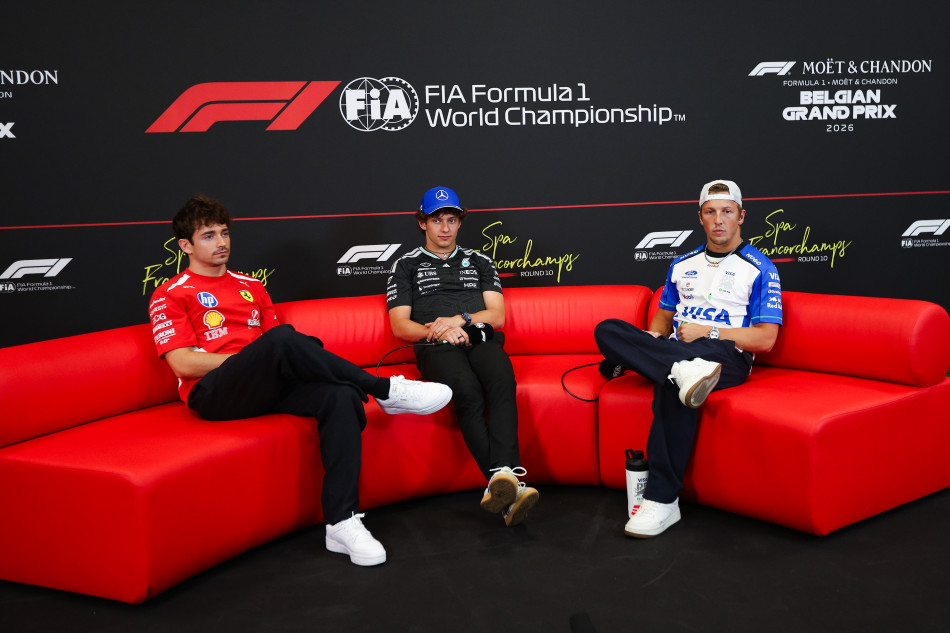
PART TWO – Charles LECLERC (Ferrari), Kimi ANTONELLI (Mercedes), Liam LAWSON (Racing Bulls)
Q: Charles, why don’t we start with you, please? Congratulations once again on the win at Silverstone last time out. Just how much confidence does your success there give you coming to Spa?
Charles LECLERC: It feels good, and this I cannot hide. Obviously, after the previous races where I was struggling with the car and trying to find a feeling with the car, it feels good to see that the work pays off. At the same time, as I said, it was only on one track, and now I want to reproduce that on different tracks. So, yes, it felt good, but in terms of confidence, I’m always confident that if I do a good job inside the car, then the results come. If I feel confident with the car and just at ease with the car, the results will follow. For that, I need to work, so it’s what I’ve been trying to do in the past few days: to try and understand, first, why we were much better than what we expected at Silverstone, in order to try and reproduce that more often in the future.
Q: What do you understand after the work you’ve put in on the simulator?
CL: On my side, why I felt more comfortable, I already knew at Silverstone what I had changed and what made me feel more comfortable. In terms of overall performance, there are still, I think, some things that we need to dig into more. I think for us to understand them fully, we need a few more laps to try some things. But, yeah, it was still quite a surprising result for us at Silverstone.
Q: In terms of the pecking order, who do you think comes into Spa as favourites? Is it Ferrari, or is it the man on your left?
CL: No, my position is the same one as I had before Silverstone. For me, Silverstone and Spa are two tracks that will suit Mercedes a lot better. However, at Silverstone, it was honestly a surprise for us also to be strong. But we were also lucky on the Sunday because Kimi was probably as strong as what we expected. So, yeah, I think in Spa Mercedes is still the favourite.
Q: Final one from me. You’ve been busy since the British Grand Prix. You’ve been in Spain and done some laps of the Madring. Can you just give us your thoughts on the track? What did you make of it?
CL: I did some laps behind a Stelvio, or whatever that car was. Obviously, it was in the middle of the works. There was still so much work, and there was so much dirt on the track. But it looks like a cool track, and I love city tracks. It felt like a very challenging city track, which has all the characteristics that I like. So I cannot wait to try it properly once we go there for the race weekend.
Q: Does it have a nice flow?
CL: Yeah, it does. But again, with the dirt that was on track, it’s not like I could push flat out. It’s difficult to comment on that, but it looks like a cool track.
Q: Kimi, let’s come to you now. Can we throw it back to Silverstone first of all? You had a lot of pace, but it turned into, obviously, a frustrating Sunday. What positives do you take from that weekend?
Kimi ANTONELLI: It was a very strong weekend overall, so that was the positive. We were up there in every session, and that was a positive, to see that the pace is good and the momentum is still there despite a few difficulties that we had previously. So, yeah, that’s a real positive. On my side, I just need to deliver and try to maximise all the things that I have in my control. The rest, I cannot really do much about it, other than just try to drive as fast as I can and keep delivering in performances.
Q: How much frustration is creeping in? Two of the last three races now, you were on for big points and it didn’t happen because of circumstances outside of your control.
KA: Of course, it’s very frustrating, but this is motorsport, so things like this happen. Of course, I think now it was enough, but it’s part of motorsport. As I said, these are external factors that you cannot really control. So I just need to maximise every opportunity I get, try to maximise what I have in control, and then we’ll see what the rest will be. But it’s part of the sport, and the team are doing a tremendous job to make sure that all these issues are not happening again.
Q: Tell us about your expectations for Spa this weekend. Charles thinks you guys are going to be quick.
KA: Our car has been quick at every race, so for sure I’d expect us to be up there. But Ferrari were also very strong at Silverstone. It was a surprise, but to be fair, we always kind of expected them to be up there because, especially when it comes to qualifying, they seem to find some extra time. So definitely we think they can be up there this weekend. Then, of course, you cannot write off Red Bull and McLaren because they can always come out and be fast as well. As always, I’ll just focus on myself, but we’re pretty confident that the package is going to be good because it has been good all throughout this year.
Q: Liam, let’s come to you. Can we start by talking about something non-F1 related? You drove Bruce McLaren’s GT40 at Goodwood last weekend. You said your hands were shaking after the run. Can you explain why it was such an emotional moment for you?
Liam LAWSON: Yeah, it was pretty cool. Obviously, growing up in New Zealand, motorsport in New Zealand and Formula 1 especially, there’s a lot of history. It’s been a long time since the success of those guys. Obviously, Bruce starting McLaren, and that car specifically is what won that race. There’s a pretty sick movie that’s about it. It’s obviously more about the Ken Miles car, but it’s in the movie. For me, as a New Zealander growing up learning about the history, and having relationships and mentors with people who were close to, or knew, the families of Bruce and Chris Amon, it was very, very cool. So, yeah, very special. I probably won’t ever have a feeling like that again in a race car.
Q: What about this year, then? You’re enjoying a tremendous run of form. You’ve scored in seven of the nine races so far. What pleases you most about the performances?
LL: It’s been very good. The car has been working very well. I think it’s just the progression. That’s probably the most satisfying part. Just the fact that each upgrade we’re bringing, or each area we’re focusing on, we’re managing to execute and find those gains that we’re searching for. So, yeah, it’s been really, really good. Obviously, it’s motorsport. Kimi has gone through the last couple of weekends where sometimes there’s stuff that’s going to happen that’s out of your control. But right now, everything that’s in my control I’m trying to focus on, and it’s been bringing results, which has been great.
Q: On a personal level, do you think you’ve taken a step forward this year?
LL: I think so, but I think that comes as well just with more experience. The more races you do, compared to how I was when I came to Formula 1, naturally you learn and you get better. So, yeah, I think so. I’ve been very focused on trying to extract everything out of my own performance as well, so on that side I feel very good.
Q: There are upgrades this weekend. I think Isack has got more than you, perhaps, but what are your hopes for this one? Do you think a double-points finish is possible again?
LL: I hope so. Let’s see. I think it’s a track that should be reasonably similar to Silverstone. I think it was a good track for us. There’s no reason why we shouldn’t be strong. Obviously, we have new parts on the car, more on Isack’s side, but let’s see what they do. Hopefully they work for us.
QUESTIONS FROM THE FLOOR
Q: (David Croft – Sky Sports F1) Kimi, we all needed a rest after Silverstone. I’m sure you did as well, and then you found yourself sitting in the Royal Box at Wimbledon, chilling out for a bit. Up pops Roger Federer for a chat. Not a bad thing for a 19-year-old championship leader to do, chatting to an experienced Grand Slam winner like that. Did you ask him for any advice on coping with pressure and being at the top of the game? If not, what could you learn from Roger Federer’s game that could apply to you in your position?
KA: It was great. It was my first time at Wimbledon. In the past couple of years, I’ve got more and more into tennis. Obviously, also knowing Jannik, you start watching. So, it was a really cool experience, and also to be able to talk with Roger was great. He told me a lot about the grass court and also from his previous experiences. It was just great to chat with him about anything, to be fair. We chatted about my races. We chatted about when he used to play, and also about his life in general. So, it was great because I think he’s also, other than an incredible athlete, an incredible person as well. Very humble and very open. So, it was great. About pressure, he just told me to really focus one race at a time, just focus on what you can control, and also to control the emotions, especially the ones that can make you do mistakes. Those were the main pieces of advice. Other than that, it was an incredible experience to witness.
Q: (Raphael Sampt – ServusTV) Charles, the season is becoming more and more of an upgrade battle. Everyone is bringing new parts to the cars. Is there a concern from your side that this will cause some issues later on in the season regarding the budget cap?
CL: On that, I trust Fred more than anything. Of course, there’s a lot of work from the team to try and push production, and to try and push the creative minds behind the team in order to have upgrades as quickly and as efficiently as possible. I’m sure Fred is on top of that. So am I worried? I am not, because I fully trust Fred and I know that he knows what he’s doing. So, yeah, you probably should ask the question to Fred more than me.
Q: (Alessa-Luisa Naujoks – RTL Germany) Charles, you won your first-ever race here in Spa. What does that track mean to you, and does it give you a special feeling coming back here?
CL: It’s a very, very special track. I think it’s a track that we all enjoy as drivers, and surely I always feel special coming back here, for two reasons. One, obviously, for my first win, which is a moment you never forget. But it’s also where I lost a friend of mine, Anthoine, and so whenever I come back here, he’s always somewhere in my mind. For these two reasons, there’s always a particular and special feeling coming here. But it’s a track I really enjoy. I’m looking forward to trying it. At Silverstone, obviously, with those new cars, we were all very sceptical about how it would feel. I kind of carry a little bit of that feeling on a track like this, hoping that it will be as exciting as it used to be. But it was much better than what I expected at Silverstone, so I hope it will still remain an iconic track even with this new generation of cars.
Q: (Roldán Rodríguez – DAZN Spain) Charles, a little bit more about Madring. Spa-Francorchamps has Eau Rouge. Silverstone has Becketts and Maggotts. Do you feel like La Monumental, the cambered corner, has the soul to become a special corner? Also, about the layout, do you feel like it’s going to fit well with your style?
CL: La Monumental, no? It’s called that. Yeah. It’s a very, very special corner. It’s a corner where I feel, in qualifying, we’ll have to – I won’t say it in an polite way – but we’ll have to be very brave because it’s going to be on the limits. So that’s going to be really cool. I think it’s going to be a really cool corner. And, yes, I do believe it can become one of the most iconic corners of the season, especially once the grandstand is built. I think that will add also to the experience of that corner. Can it fit my driving style? I like city tracks in general, so I have little doubt that I’ll love Madring. Whether it will fit me or not, I don’t really know. But one thing for sure is that you will have to go full commitment, and this I always enjoy on city tracks.
Q: Charles, how different is that banked corner to the final corner at Zandvoort?
CL: The final corner at Zandvoort is actually flat out. Maybe Turn 3 at Zandvoort is really cool as well. It’s slower, though. But at Madring, it doesn’t look flat as of now, at least. I was very, very far from being flat during testing, mostly because of the dust that was on track. But it’s just a very, very cool corner, and I can only imagine the way it will be during the race weekend. It will be very much on the limit.
Q: (Mara Sangiorgio – Sky Sports Italy) A question for all three of you. After so many races, and considering the understanding of everything, is it still right, in your opinion, to maintain the five-second pre-start procedure?
CL: I would be happy to shorten it a little bit, but I don’t think Kimi will agree with that.
KA: I’m happy to stick with it.
LL: I don’t really mind, to be honest.
CL: No, jokes aside, I think we’ll have to keep it with these cars, just because it’s physical. The limitations are always going to be there, and we still need this lead time before all of us are ready. Some will want it to be a bit shorter. Some others will want it to be a bit longer or the same. But, yes, some lead time we will always need, I think, with these cars.
Q: (Andreas Gröbl – ServusTV) Kimi, you’re leading the championship and you’ve done so for quite some time. We’re into weekend number 10, which could easily be the halfway point of the season. Looking back to the first half, this is usually when kids in school get their first certificate. Would you rate your own season as a 10 out of 10, being the humble and self-reflective driver we’ve got to know? If not 10 out of 10, why?
KA: No, I wouldn’t say 10 out of 10, for a few reasons. First one, Australia FP3. That was not good because then we almost missed qualifying. We couldn’t set up the car properly and stuff like that, so it compromised a bit the end of the weekend. Then I would say Japan. Yes, I did win in Japan, but I had a really bad start. Obviously, we extended the stint and then we were lucky with the safety car. Then I would say, more recently, the Miami sprint race track limits, Barcelona qualifying, mainly Spielberg qualifying. So there are a few things. I would say eight and a half out of 10.
Q: (Craig Slater – Sky Sports) Another numbers one for Kimi. George said after Silverstone he thought 25 points was more or less fair, based on the bad luck he had and maybe you having a bit of bad luck. Do you agree, Kimi? Despite the bad luck, do you think you’re driving as well, if not better, than when you were winning the five races in a row?
KA: It’s really hard to judge because, yes, he’s had bad luck, for sure. Monaco was one of them. Of course, we wouldn’t have known how the race would have ended because we were both neck and neck. It was impossible to know. But for sure, yeah, he was very unlucky because at that point he was leading the race and he had to stop. Then there were a couple of other times that he was a bit unlucky. In my case, we were going towards a result that was almost certain. Barcelona was P2. Silverstone, we cannot know because I didn’t have a shot, but I think we would have been in the fight for it. So for sure, we know those would have been certain points. I have to say both of us had bad luck. One of us had it in more critical moments at times, but as I said, it’s the way it is. This is how motorsport goes, and we all know that. We could see ourselves how this can shift very quickly. As a team, definitely reliability has not been our strongest point, and we’ve realised that is something we need to keep working on. For example, Ferrari seems very strong on that side, so we just need to make sure. I know the team is working super hard to make sure that these things don’t happen. But if I look back after this first—this is weekend 10—if we look at me and George combined, we lost lots of points. Then if you look at the Constructors’ Championship balance, it’s definitely a big hit. But as drivers, in this case me and George, we just try to do our best and make sure we use every opportunity we get.
Q: (Andrew Benson – BBC Sport) Kimi, you mentioned Jannik Sinner there. Who is more famous in Italy? How are you coping with the adulation when you go home? What’s it like to be suddenly in this sort of famous position, meeting people like Roger Federer and what have you?
KA: More famous in Italy is Charles, right now. He’s probably the most famous man in Italy. I don’t know, because I’ve never been with Jannik at the same time in Italy, so it’s hard to say. Sorry, I just don’t really know how to answer this. Sorry, the other part of the question was how do I cope with that?
Q: (Andrew Benson – BBC Sport) The adulation, Kimi, when you go home. How do you deal with that, and then just being famous generally?
KA: It’s great to see the support when I go back home. Also because, as Italians, we’re quite emotional. We show our emotions a lot. So to see the excitement is great. However, you also need to be careful with the expectations that are built. But it’s always great to be back home, especially after a good weekend, to see so much support. Also, to the other question of being famous, for sure there are times where you would like not to be recognised when you do certain things, when you go for dinner. But that’s also part of being an athlete. To be fair, as long as you’re able to embrace these moments, I think it’s also very nice and very enjoyable. But, of course, there are times where I would like to be unrecognised. At the same time, I know it’s part of it, and I’m very happy this way.
Q: (Carlo Platella – FormulaPassion.it) Charles, could you explain what you were struggling with before the changes you did at Silverstone? Do you think they had more to do with the Ferrari itself, or with this generation of cars?
CL: No, I don’t think it’s with the Ferrari itself. I think it’s more with this generation of cars. I’ve got quite an aggressive driving style in general. I think that has been a strength during my career, but with these cars, sometimes you’ve got to be careful not to go to the other side because then the dip is quite big and you can start losing quite a lot of performance. PU-wise, if you are not efficient, if you don’t go on the throttle in a clean way, if you just don’t do things consistently, always the same, then it starts becoming a bit tricky because you get into very different issues where your speed into the next corner is different. That changes your braking point, and you are always readapting your references. It makes it very, very difficult. So, I think there was a little bit of that. Then there were just a few things that I changed at Silverstone to try and fit this generation of cars and to try and help my driving with it. That made it quite a lot better. But as I said at Silverstone, this is something I want to prove on multiple racetracks. It’s not only with one race win—and I’m very happy with the race win—but it’s not only with one race win that now everything is fine and I’m relaxed. There’s a lot of work in order to try and keep that form and keep that feeling, most of all, because if the feeling is there, as I was saying earlier, it has always been the case that when I feel good with a car, normally the lap times and the performance come. So I’ll just try and work as hard as possible to try and keep that feeling for the rest of the season and on different track layouts.
Q: (Diletta Columbo – AutoMoto.it) A question for Charles. What was the actual turning point in your understanding of your car?
CL: It’s very difficult to say because it’s not as easy as there being one moment where you realise everything you’ve done wrong. It’s a lot of work and trying to understand in the data what is making me less comfortable with these cars. But there was a moment on Friday night at Silverstone where I saw a detail and I was like, “Okay, this is very difficult to quantify, but if I happen to change that and make it more to my liking, then my feeling will most likely be a lot better.” When I did that on Saturday afternoon, when we could change the car, things were a lot better. So, yeah, that’s a good thing. But unfortunately, I cannot give much more detail. I don’t know if it makes much sense to keep trying to explain it without giving the details, because there’s very little sense in what I say that way. But just to say that it relies on very fine details, and it’s not as black and white as it might seem. But it was cool to see that it paid off.
Q: Can you shed some light on whether it was just braking, or was it deployment? Without getting into specifics, can you tell us?
KA: It was everything: braking, accelerating, turning!
CL: Exactly, everything. No, I can’t go into the detail of it. But no, it was a bit of everything, and it was in a particular part of the corner. It was not braking. And I feel better with it.
Q: (Leonid Kliuev – GrandePremio.com.br) A question for all three. Safety car rules will probably be discussed at the drivers’ briefing. Should we change the rules after the closing laps at Silverstone? Who’d like to start?
CL: I was very happy about the ending at Silverstone, but I think most people will argue that it’s not a nice way to finish a Formula 1 race. Safety needs to be the most important thing in those moments. I feel like there will always be some people unhappy about the way something is managed. It’s true that it’s always a shame to finish a race under the safety car. I didn’t fully understand why. I think there was a rule that says that once the cars are unlapped, you need to wait one more lap. This is maybe something we can look into. Whether it would have changed significantly, I’m sure there will be plenty of scenarios where it’s just not quick enough to recover a car, and then you end the race under the safety car. I think the right thing is the safest thing to do, no matter how it is for the show.
KA: There’s not a lot more to add. If the rules are like this and they’re respected, then it’s all good. For sure, there will be times where the race will restart and times where the race won’t restart, like it happened at Silverstone. But these are the rules. For sure, as Charles said, there will always be someone who isn’t happy and someone who is happy. So, you can’t make everyone happy at the same time, all the time. If these are the rules, we live with it. If we’re not happy, we just suck it up and focus on the next one.
LL: Yeah, not much to add. I think maybe in NASCAR they can’t finish under the safety car, or they always do one more lap. They pause or something like that with a lap to go, or they just add a lap. I don’t know if we could do that. Obviously, we have fuel levels and stuff like that to manage. But it’s a shame to end a race like that under safety car. I think if there’s a way that we don’t do that, that would be great.
ENDS
 Facebook
 Twitter


