
How an FIA research project at Zandvoort is testing new ways to capture particles from road runoff
The Dutch Grand Prix weekend at Zandvoort is the setting for an FIA research project testing whether tyre wear particles along with other pollutants such as microplastics and dust, carried by rainwater can be captured and filtered before they leave the site, work the FIA hopes will ultimately be of more use to everyday road traffic than to racing.

When rain falls on the road, it washes away more than just dirt. Tyres, brakes and powertrains all release tiny particles into the air as vehicles travel, and a share of this material - mainly tyre wear, along with dust, microplastics and other pollutants that settle on the road surface - is then carried by rainwater into drainage systems, eventually finding its way into rivers, lakes and the sea.
Invisible to the naked eye, these waterborne particles are fast becoming one of the major emerging environmental challenges facing the transport sector. It’s no different in racing, but motor sport’s governing body is taking action - starting at this month’s FIA Formula 1 Dutch Grand Prix at Zandvoort.
In a new research partnership, the FIA has collaborated with the Technical University of Berlin (TU Berlin) and German start-up Urbanfilter to install prototype filtration systems capable of capturing particles from the track surface before they reach the surrounding environment, as Nicolas Aubourg, Head of R&D at the FIA explains.
"With road cars we've had particles being emitted not only by the power unit, but also by brakes and tyres,” he says. “Those particles are released into the air and into the ground. When it rains, the stormwater collects the particles and can carry them into waterways and, potentially over time, into the sea. It is a growing problem for society, but we think that motor sport can help tackle the issue.” To illustrate the extent of the problem, a 2024 report by the OECD (Organisation for Economic Co-operation and Development) estimated that in 2020 alone some 2.7 million tonnes of microplastics seeped into the environment and that number is expected to double by 2040. And while microplastics emanate from a wide variety of sources - from the microbeads in skincare creams to food packaging and polyester clothing - the transport sector bears a heavy burden, with a 2024 international study led by the University of Portsmouth estimating that tyre particles alone account for around 28% of microplastics entering the environment globally.
Motor sport’s own contribution to that total is very small: a grand prix weekend involves 22 cars on a closed circuit, against the hundreds of thousands of road vehicles using the surrounding road network over the same period. The FIA’s interest is therefore not in its own footprint, but in using the controlled conditions of a race weekend to test technology that could later be applied to public roads.
Racing research
So how can motor sport help to tackle what is a global problem? The answer, says Aubourg, is twofold - through measurement and implementation. “If we want to improve and show that we have a filtering system that works, we need to measure the particles,” he says. “To do that, we have been working with Imperial College in London.” A recognised global leader in air pollution science and home to the world-renowned Environmental Research Group (ERG), Imperial College is helping to measure particle emission at a variety of events, including the recent Formula 1 Belgian Grand Prix at Spa-Francorchamps and the 24 Hours of Le Mans. “This was the second year that we monitored particle emissions at the Belgian Grand Prix,” says Aubourg. “They had a lab based in Stavelot and a lot of sensors in the paddock, in the pit lane, in the grandstands, etc. but also in the background, very far from track activities, to compare the level of particles with and without activities.
“What we did at Le Mans was unique in the sense that we put the machine very close to the road cars themselves and in a place where you are not polluted or disturbed by cooking, fireworks or similar sources,” he adds. “The idea is to have a pool of data that will help the research community understand the phenomenon, because it is complex. Even if we could provide data that might help the scientific community understand the problem, it would already be a legacy from motor sport to universities and researchers. It’s also very important for us, as a sport. We try to run as cleanly as possible, and we would like to use motor sport as a laboratory to trial new solutions and filtering systems and, where the evidence supports it, to feed the results into the FIA’s normal regulatory process.”
From research to real-world solutions
Measurement alone is not enough. Alongside its scientific work, the FIA has been searching for practical methods of preventing microplastics from entering the environment. Through the Audi Environmental Foundation, the FIA was introduced to Urbanfilter. Launched in 2020 the project explored how filtration could be integrated directly into street drains to capture contaminants close to their source. Through laboratory development and real-world testing, the team created a modular filter system capable of capturing microplastics, tyre wear particles and other road pollutants while maintaining effective stormwater flow.
"It’s a pretty smart system,” says Aubourg. “In laboratory testing, the system captured up to 99% of the particles in the water passing through it, with a maintenance interval of around a year. What we now need to establish is how a prototype performs in real conditions at a circuit."
Over the past year, engineers collected samples from Circuit Zandvoort to understand the specific characteristics of particles generated during motor sport events. Those findings informed the design of two prototype filtration units, which have now been incorporated into the circuit's drainage network.
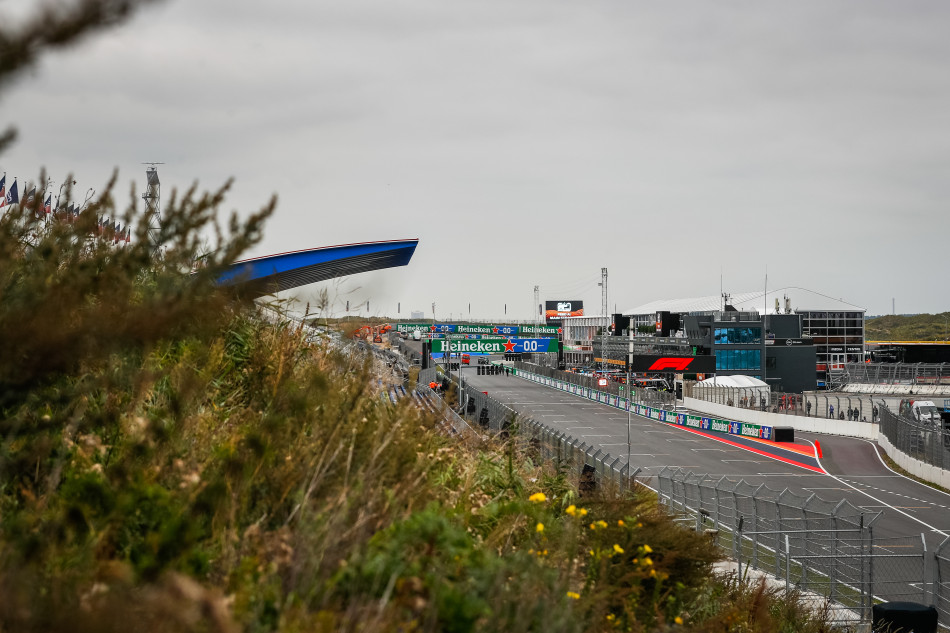
Together, the filters cover approximately 3,300 square metres around the pit lane and Turn 1, the famed Tarzanbocht, intercepting rainwater before it leaves the circuit and retaining particles that would otherwise be carried off site, so they can be collected and analysed. The installation will also provide valuable operational data, allowing researchers to evaluate long-term performance under real racing conditions.
 From Zandvoort to the streets
The Dutch Grand Prix presented an ideal location for the first deployment. Its proximity to the coastline means protecting water quality carries particular environmental significance, while its location in Europe enabled the project to progress rapidly from concept to installation.
Remarkably, the entire development process, from collecting samples to designing and manufacturing the prototypes, was completed in little over a year.
“We designed the filter and, one year later, we are here in Zandvoort with prototypes,” says Aubourg. “If we show that it’s working, then next year, with their help and with all the tests we have done, we will hopefully begin discussing the concept with other circuits. They are already interested.
The pressure on track to maximise sustainability is intense, so anything that can be done in terms of measurement, air quality, particle mitigation is welcome.” While the immediate objective is to improve environmental performance during motor sport events, the FIA's ambitions extend beyond the sport itself.
“If we do convince the promoters of other street circuits that we could install these filters, we can race with fewer particles leaving the site and leave the filters behind afterwards for everyday road traffic. That would represent a significant quantity of particles that do not go into the environment. I think it's also a legacy from motor sport to road cars that could be implemented at scale.”
Collaboration driving innovation
The project also highlights the value of bringing together universities, industry and motor sport to solve complex sustainability challenges. By combining the FIA's technical expertise with TU Berlin’s research capability, Urbanfilter’s engineering, the operational support of Circuit Zandvoort, and funding from the FIA Foundation the project has created a platform for continued research. And as the FIA continues to develop technologies that can be tested under the demanding conditions of world championship competition before being transferred to public roads, projects like the Zandvoort filtration system show how motor sport can help shape cleaner, more sustainable transport systems for the future.
 Facebook
 Twitter


