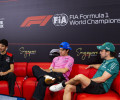
F1 - 2026 Miami Grand Prix - Friday Press Conference Transcript

TEAM REPRESENTATIVES - Mattia BINOTTO (Audi), James VOWLES (Williams), Frédéric VASSEUR (Ferrari)
Q: A question to you all first of all. FP1 done, can we start by getting your thoughts on the technical changes ahead of this weekend? Fred, perhaps we could start with you.
Frédéric VASSEUR: I think honestly, it’s never easy to do a change during the season because as soon as you want to change something on the regulation, you are impacting the relative performance of the car. But I think for once that we were able to do, let’s say, good work, even if everybody wants to get more. But at the end of the day, I think we did a step forward and I think it’s a good one.
James VOWLES: Similar comment to Fred. I think, actually, well done to the FIA and well done to the teams for working collaboratively to find solutions very quickly. And it’s not one solution, there’s sort of 20 or 30 papered and gone through. As Fred says, we’re constantly fighting against each other for relative performance but ultimately this is a change to make sure the sport is in a better place and it was good to see the teams come together.
Mattia BINOTTO: Not much to add. I think everything has been said and great efforts, well done to FIA and to the teams. I don’t think it has affected much, by the way, this weekend. Miami maybe is not the track where you can see it the most and for us, FP1 has been so messy that we have not noticed the difference. But overall, at the end, even from outside, I think the fans watching will not perceive it. Maybe the driver will feel an improvement. Further improvement for the future may be required still, so it has been our first great effort together, but still more to come.
Q: Mattia, why don’t we continue with you? Allan McNish, his first weekend as Racing Director for Audi. Can you give us some background into that decision and why Allan? What does he bring to the team?
MB: Allan, first, he’s a great person. He has been a great driver, he knows Audi very well, he knows racing, what it’s about, he understands the drivers’ language, he knows what it means being at the pit wall, not only because he has been a driver but he has been a Team Principal in the Formula E team, so he knows the paddock, the journalists. He’s well involved with all our partners, so I think it was an easy decision and a great fit. And for me overall, it’s important to have him at the racetrack. Being Racing Director, I can fully trust him because of his experience. Already this morning, he was an easy plug-in in our organisation and that somehow helped me. I’m not there at all races and he is the one that will represent the team when being on track and again, he will do very well. I have no doubt. He has proven in the past his capabilities and furthermore, I think he’s already enjoying it. I saw him at the pit wall with a smile, even through, as I said, a messy session. So that’s a good start.
Q: Mattia, this feels like a bit of a restart for Formula 1 after the break. Can we just get your thoughts on the season so far and which element of performance the focus is on back at the factory?
MB: Obviously for us it has been a new start as well as a project, Audi F1 project, from Sauber to Audi. It’s brand-new regulations and I have to say overall we are pleased with what we have achieved so far. It’s very easy to make things wrong in F1 and you can see around us other teams have more difficulties. So, as a brand-new team, brand-new manufacturer, we are pleased. Pleased doesn’t mean to be satisfied. There is much to come. Our ambition is very high. Our long-term ambition is very high and when we look at the performance on track, still there is a big gap to the top competitors, which is not a surprise. Top competitors are very strong organisations, well-established organisations, and we know that in order to close that gap there is a lot that needs to be done. What there is? People, team size, infrastructures, capabilities, tools. But when assessing the performance on track, I think the most obvious is the gap we’ve got on the power unit, which again for us is not a surprise, it was expected. Being a brand-new engine manufacturer, you may expect such a gap to the best organisation. But here we’ve got plans ahead. It’s not a matter of being desperate. On the opposite, I think it’s assessing where we are. It’s a big, a huge gap, we believe, but we’ve got a plan of development for the future and we are focused on that.
Q: Mattia, thank you for that. I’m sure there’ll be some more questions for you in a minute. James, why don’t we come to you next? It’s been a frustrating start for Williams in 2026. How much progress do you feel you’ve made this weekend after the break?
JV: Yeah, a really messy winter and the break gave us an opportunity to reset, take a breath, catch up, form a plan for not just Miami, of which we brought upgrades here, but really what we’re doing now across everywhere up until the end of the season to put ourselves back into a sensible position, fundamentally. I am proud of the work that the team did. Every area was basically working at maximum capacity and that’s despite a difficult winter where people were putting in big, big hours. However, the gap is so large from where we are to the front that I’m sure we’ve made a small step into that, but it is a small step and we need to keep doing that across the number of races in the future in order to make a tangible difference. So positive first session but it is literally just one session and the gaps are still large.
Q: So, what does success look like for Williams over the remainder of 2026?
JV: For me, it’s as we get to where we finish developing the car, which will be after the August break, that the car is sensibly back to being the top of the midfield, with everything in a sensible position, building on next year’s car. In other words, the engineering we’re doing. So, the engineering that’s been done over the last five weeks is… all the weight is removed from the car, plus, it’s not delivered yet, but the engineering work is complete, plus another 10 kilos on top of that. That’s a sensible step. Pit stops are back to being in the top three, top four. There’s 150 pit stops completed. That we bring aerodynamic performance that translates on track. So here we’ve had an aero update and exhaust, although Fred was taking the mickey out of me that it’s a tiny little sliver for weight saving but it’s still good to see that across the board we have about 40, 50 performance projects and when they come, that they do deliver the performance we’re expecting.
Q: That’s a nice segue into my final question to you all. HR departments have been busy in the last few weeks but you have announced Dan Millner, ex-Mercedes, joining the team. When will his influence permeate through onto the car?
JV: It’s already starting now. Dan’s someone I worked with for many years at Mercedes. We’ve also had Claire Simpson from Mercedes join us today. It’s her first starting day. We’ll go through and do announcements on all this shortly. But there’s some great people coming over the next three months, fundamentally, three, four months, there’s more than that. But the impact that Dan has made to your question is already very significant and very quick. So we are doing swathes of work that he has experience on and actually we are taking a slightly different direction as a result of his input that has already come through now. And what I enjoy about Williams is there is no resistance to change for greatness. In other words, what I mean by that is we will point ourselves in the right direction and follow along with that as long as there is clear ambition and drive to this being at a championship level and Dan brings that.
Q: OK, thank you for that. Fréd, let’s come to you now. A lot of upgrades on the car this weekend. What’s the initial feedback from the drivers?
FV: It’s positive but I think also that we have to keep in mind that it’s the first session of the season with this sort of track temperature and this is dominating everything, I think, for everybody. But overall, the first feeling is positive but we’ll see the real feedback and the real feeling after the quali.
Q: And what about the opening three races, podiums in all of them? How do you reflect on the job done so far?
FV: It’s perhaps difficult to draw a conclusion after three events but clearly Mercedes is a step ahead. They did three pole positions, three wins. Nobody can say something else. Overall, I’m quite happy with the fact that we didn’t leave a single point on the table, that efficiency is key, and everything went well on our side. I don’t want to speak about potential but strategy picked up everything. That means that we probably maximised the number of points that we were able to score on the first three events but still a long way to go.
Q: You don’t want to talk about potential, I’d love to ask you about potential because both drivers have said this is a really good car, and I’m talking about the chassis. How much potential do you think it’s got?
FV: Well, we are all at the beginning of the development. We took probably different directions and only the future will tell us if it was the good one at the beginning or not. But we’ll see later on during the season. But development for this races and the next one, we are still on the phase to have a high rate of development. It’s true for us, it’s true for everybody, and we will see after six, seven races perhaps something a bit more stabilised.
QUESTIONS FROM THE FLOOR
Q: (Rachel Brookes – Sky Sports F1) Fred, could I ask you first of all, there is this ADUO, as it’s being called, the Additional Development Upgrade Opportunity. Do you believe that your Ferrari power unit will fall just outside of that two percent in terms of you’ll be able to use this opportunity for your power unit?
FV: Honestly, I think so. But I think everybody has the same feeling and at least the same quotes. Now we have to trust the FIA. They will come back to us with numbers soon and we have to rely on this. But at the end of the day, we are speaking about percent and I know perfectly that it’s not easy to assess but if you have an overall look on the straight-line speed, that it’s yeah, OK…
Q: (Sandra Baumgartner – Sky Sports, Germany). Hi Fred, I want to talk to you about the ‘macarena’ wing. Was it just testing today or do you really plan to run the wing this weekend?
FV: No, no, from today, we’ll keep the ‘macarena’ on the car.
Q: (Mara Sangiorgio – Sky Sports Italy) A question for all three. The first three races have also left some question marks from those watching this F1. How is F1 responding to this and what do you say to those who are calling for the return to V8 engines?
MB: First, I should say what are the comments of our drivers. Our drivers are enjoying the current format and I think it has been a big change as to the past. Everyone needs to adapt to the changes. But overall, I think if you look and you watch the races, for the fans it has been a great show as well. Overtaking since the very first race, close fights, which is not obvious when you’ve got such a big discrepancy in the regulations. So, I think the format is a great format and F1 remains a platform for innovation at the edge of the technology. The fans know that behind there is a technical challenge. So, what will be the future? I think it’s too early to say. Certainly, we have started discussing it with the FIA. We will, I think, sit down, discuss what’s the best for the F1. But I will not be so negative on the current format. Overall, I think it’s a good format. We have slightly changed the regulation to fine-tune it, try to improve. Maybe we’ll do more in the future in the next seasons but I think we should be also somehow as well positive on what we can see. And if you look in the past, I think there have been eras where Formula 1 was more boring. So overall, I don’t think we should be so negative. Audi has always looked for high-efficiency engines and I think that’s important to us and we certainly discuss with the FIA what’s the best compromise for the future.
JV: Easier for me to talk about because I’m not a PU manufacturer, so I can only give you opinion on this one. But I would say in Bahrain and then post-Shanghai, the FIA and teams have been very collaborative and having discussions about, “Is the product in the right place and what can we do to tune it?” And that’s why you see the changes now. And exactly to Mattia’s point, I am confident we will go back to the table after this and make sure we are in the right direction of travel. If there’s more changes needed, review those for what they look like in the future. But that openness just shows you that we as a sport are aware that I think we still have a great product. I think there are always refinements that we can do and we’re looking for that pathway to what is the best outcome. This is now into opinion because I don’t have to make a PU, but I’d love a V8 back. Miss those days.
FV: Yes, Mara, I would be less harsh than you on the show of the first three events. Honestly, we had good races, a lot of overtakings. You can say that perhaps you have the feeling that it’s a bit artificial but for me it’s much less artificial than the DRS. DRS was just to push on the button. Today, it’s energy management and it’s coming from the drivers or from the team. It’s not artificial at all. And I would say that for sure we have to fine-tune, we have to adapt. And as James said before, thanks to the FIA we had the capacity to discuss after each event to try to improve the system. Once again, it’s not easy to do it during the season but we are, I think, all collaborative with this. Regarding the future, we have different options on the table. I think it will be soon time to discuss about the different options. But from the beginning we have one parameter in mind, it’s also to reduce the crazy budget of the engine. And this is for the PU manufacturer but also for James and customers and for the benefit of the F1. I think that now we can discuss about all the opportunities and we’ll have time to do it soon.
Q: (Rachel Brookes – Sky Sports F1) James, you mentioned the work that was done in that break and the amount of weight the car had lost. Could you clarify for us the figures? I heard you mention 10 kilos. Is that what you’ve lost or is that what’s left? What are the figures at the moment?
JV: Thank you for noticing. It’s a couple of kilos. It’s been hard! No, what I was mentioning there was the engineering work that they’ve completed is all of the weight out of the car and 10 kilos below. So that’s the engineering work that’s been complete. It’s not delivered to the car because in cost-cap world it’s just not efficient to do that anymore. You’ve got to be careful about bringing product to the track at a point where it’s effectively out of life and out of cycle. But what I’m pleased about is already the demonstration that we can engineer the car at the right level to have it at the right weight is complete and done. That’s what I’m looking for. The production of it will take a bit of time now. In terms of weight here, it is a couple of kilos and every race will be a couple of kilos, fundamentally.
Q: (Scott Mitchell-Malm – The Race) A question for Mattia and to Fred. What’s your understanding of where the discussions around any engine ADUO changes have got to? When do you think you’ll know what you can do and has it left the engine manufacturers in a bit of limbo at the moment on what happens next?
MB: I don’t think we are in a limbo because as a matter of fact, there is a regulation in place and the regulation somehow states clearly where we are, by when the assessment will be completed, which is after the sixth race of the calendar, and what will be in case of ADUO, or let me say gap to the best, the opportunity of extra development budget, dyno hours. So, we are not in a limbo. What we have discussed in the last weeks with FIA is how we may support maybe manufacturers which are in a true difficulty, far behind on their, let me say, plans or programmes. And so far, we have not achieved an agreement, but that doesn’t mean we are in a limbo. It means that simply we stick to what we’ve got at the moment. I’m pretty sure that FIA will come back again with some more discussions and we will be supportive certainly to discuss that with them.
FV: Not that much to add but I’m fully OK with Mattia that the situation is crystal clear and that the only open point perhaps is that, as we said, it was after six. Is it race six of the initial calendar or race six of the new calendar? But on the mechanism, what you can do, the dyno hours and so, this is crystal clear. The parameters to consider the performance are also clear from day one and I don’t see any issue on the current situation.
Q: (Ian Parkes – RacingNews365) James, you mentioned at the start that it had been a messy winter for Williams. For a team that started looking at these regulations probably the earliest of any of the teams last season, why did that prove to be the case? And just a follow-up question: Carlos Sainz mentioned yesterday that it would be unlikely that the team would shed all the weight off the car until late in the season. Why is also that going to take so long now as well?
JV: So, why messy? We made a lot of changes a few years ago, putting in ERP, PLM systems, different ways of doing planning, different ways of structuring, different ways of working, and this was the first proper car build where all of those brought into account. I think we have made some mistakes on some of that software that we’ve been using. It was our first proper go at planning a completely new regulation car from start to finish. And when we went through effectively a global review of all of that, it’s tiny, small details but hundreds of them starting to add up. So, there were just inefficiencies across the board that weren’t taken into account and only came to light once you started stressing the system. Whilst we started early in the wind tunnel, no doubt about that, we did not start the build of the car early because what you want to do is keep all of that goodness in the wind tunnel as long as possible and we wanted to stress ourselves to the point of not quite a championship team but more aggressive than we had done before. The car we produced is the most complex. It doesn’t matter if I use number of parts, it’s about two times the number of parts. Doesn’t matter if I only use the number of parts in the chassis or the time it took, all of it was about one and a half to two times more complex and it didn’t go smoothly through much of that process.
And your reaction, it might not seem this way, but your reaction once that starts to happen is there is very few alternatives. You can’t really go to outside manufacturers because they are all booked up by other individuals. So, once you start falling behind, you’re in trouble. There was a number of crash tests but some were passed incredibly well, some were difficult, frankly, and that put load back into a system at a very difficult point as well. Once you start running out of time, weight is quite an easy addition to effectively get a part through to make sure that you are in a sensible place. It comes basically into a heavy car very quickly as a result. So that’s sort of a ballpark summary of it. The why does it take so long to get the weight out? As I said, the engineering’s work is done, so the designers aren’t designing, fundamentally. But you have to make sure you’re printing the components in a way that makes sense. So, in other words, we could take out, and we have this weekend, several kilos out of the floor because we’ve done a new floor. I don’t want to just make exactly the same front wing being several kilos lighter. That doesn’t make any sense to anyone. So, you’ve got to body that into an aerodynamic update at the same time. And so that’s the efficient way in cost cap of doing it. We could right now take out, if there’s no cost cap, print the other bits in the car. We have capacity, we’d take out pretty much all the weight. But there’s some mechanisms that we have to do along that journey. It’s painful but it’s balancing adding aerodynamic performance as well as weight reduction.
Q: (Stuart Codling – Autosport) Yesterday, Lewis Hamilton said it’s high time that drivers had a seat at the table when it came to discussing and formulating the new technical regulations. I was wondering what your thoughts are on how feasible and desirable that would be and how it would actually work because presumably one seat at the table, fine; 22, you’re going to need a bigger table.
FV: We are still looking for the table! No, I think a good example was that drivers, they were part of the discussion on the modification of the engine the last couple of weeks. It went well. For sure, they have different point of view and it’s not always easy to find a compromise. But they are part of the discussion and they will be part of the discussion, as we are also on our listening to them and discussing with them and bringing somehow their feedback to the FIA when we are discussing about the regulation. They are not excluded at all from the system.
JV: A mirror of that. I know Carlos was, for example, consulted. Nikolas did a good job by bringing him on board, asking the questions before we went through this regulation change to make sure he and others were part of that process. I think the facts are behind it. We’re already probably too many around the table to discuss because you just end up going around the circles. Adding five more of us isn’t going to help. But what is taking place in the background now, for example, there’s a form overnight making sure the drivers can fill in their views on certain aspects of things. And I think having a representative, either pre-meeting with the FIA or in the meeting, is probably somewhat sensible. We just need to make sure that we’re not driving towards the direction of one PU manufacturer and using bias, that we really do hear the opinion of what’s required from the drivers.
MB: Nothing to add.
Q: (Alex Kalinauckas – The Athletic) Fréd, a couple of races ago Charles Leclerc became the second most experienced Ferrari Formula 1 driver and at the current rate he’ll overtake Michael Schumacher in 2027 and be the most experienced. What do you think that says about his place in the team’s history and his achievements and longevity of the team? Thank you.
FV: Charles is in the team for ages, he was into the Academy before, to go to Sauber and to come back to Ferrari. He’s part of the performance for sure as a driver but also of the development, of the integrity of the team and the team spirit. I’m not a big fan of statistics and I don’t know when he will be the number one or the number two, and we are much more focused on performance, short-term performance, than about statistic for 2027 or whatever.
Q: (Thomas Maher –PlanetF1.com) A question for Mattia, please. Mattia, the opportunity of the break and the filming day, how confident are you that you’ve been able to make a step forward in relation to the weakness of the race starts? What have you been able to do to improve that? And given that you’ve been quite open about the weakness of the power unit, just how potent do you think the Audi chassis is in terms of the pecking order?
MB: As far as the filming day, filming was the main purpose of the filming day. No smiles, that’s true. And yes, we took the opportunity of making some starts. If I look at the start we made in Japan, for example, a lot of wheelspin, both cars. So, drivers somehow in terms of procedures not applying the right procedures in the start. But the reason why both drivers made the mistake is because our calibrations, our tunings, our software and strategies are so green at the moment, changing race by race, because really as a brand-new manufacturer, again, the reliability, control software, it’s a continuous development that they never had the chance to have a stable system where they can practice in a stable system. So, I think in that respect, more they practice, and again here in Miami more they practice, more it will be important to them to have a standard start at least, I would say. I don’t think that our start will be ever great with the current hardware we’ve got, but certainly not maybe qualifying Q3 and finally finishing P19 at the first lap. There is a lot of room of improvement.
Back on the chassis, I don’t know where it stays overall in term of positioning, but I’m happy because there are no fundamental issues with the chassis itself or the aero. The car is behaving as expected. The car is behaving well, correlated to the wind tunnel and the simulator, which is the main base when you need to develop a car. We do not have overweight problems, which is lucky for us as well for what was our team in the past, and that’s something that put us in the right position to develop furthermore the car. So, I’m pleased to see what we’ve developed on the chassis. As much on the engine, how I was stating that the gap is significant and most of the gap is no power unit, but still I’m pleased the way that the team is working and what has been achieved so far in our journey.
Q: (Adam Cooper – Adam Cooper F1) One question for all three of you. Going back to the influence of the drivers on the regulation changes, all three of you had a guy directly involved with the FIA meetings. Do you welcome this new era of driver power or do you have any concerns that there might be times when their interests diverge from those of the team?
JV: I can comment on the drivers that I have. The interests are for that of the sport. I mean, I’m sort of pragmatic to it and again, it’s easy for me to talk about because we’re not at the sharp end right now. But the reason why we’re successful commercially is the sport is in an absolutely place and I still think the sport is in a great place and growing year on year. And Alex and Carlos reflect that in their comments that I go out with it. So, it’s not tailored to what will make Williams better. It is tailored to what they want to get the most out of it in terms of drivers and what they believe will be the right product for the sport. And I think as long as we approach it from that angle, there’s no issue.
MB: First, I think we should remember that there is a governance body, FIA, who are writing the regulations. No one else is writing the regulations. And when you look as well at 2031, which will be out of the Concorde Agreement, once again they will be the one fully deciding what’s the future. I think FIA is simply listening to everyone at the moment to make sure that whatever they are proposing is going in the right direction, and I think that it’s a proper process. So, I don’t think that drivers will have more influence than in the past. Simply, they are listened to, as they may have been listened to as well in the past, which is, as I said again, a healthy process. We are in a situation where it’s a brand-new regulation, really brand new, a lot different to the past, and I think that simply FIA again is doing the right job by listening, hearing, discussing, putting people around the table, technicians, engineers, Team Principals, drivers. As I think Fréd said before, it’s already difficult to change our regulation during the season and that has happened. And it has happened because we had a broad consensus around the changes, and the only way to achieve it somehow is to make sure that we have well listened to everyone and found a common ground.
FV: Not that much to add, except that for sure the drivers, they are involved from day one into the discussion because the feedback that we as a team have from the car and so on, it’s also built up on the experience of the drivers. It means that they are completely part of the discussion. And then keep in mind that we have a governance. If the sport is going well today, it’s also because the governance is working and that we were able to do changes. Honestly, I was very surprised that we could achieve something during the season because for me it was something… Not a bit strange but a bit exceptional because in this kind of situation, everybody wants to have his own advantage and we were able to move forward in this situation. It was a good step but drivers are fully involved in the discussion.
Q: (Graham Harris – Motorsport Monday) Question for all three of you. Aren’t these latest changes that have been brought in by the FIA more rearranging the deck chairs on the Titanic when there’s a fundamental requirement, apart from Mattia’s drivers, we are hearing anecdotally from all the other drivers saying just how unhappy they are that they’re not driving flat out all the time, which is what Formula 1 is supposed to be.
MB: As in not driving flat out, it’s not a good reason. I think in the past, when we had to do a lot of fuel saving, they were not driving flat out as well. So again, I can only say what our drivers are saying, they are very positive with the regulations. They are enjoying the car, I think, and I’m not sure that all the drivers are not enjoying it. And again, so I think the regulations are different to the past, yes. Drivers need to adapt, yes. A different driving style is required, yes. But it is still F1. It’s still a challenge. It’s still a race and fighting on track, so fighting for the fastest lap in quali, in the race, and at the end there is a winner, a loser, and I think that’s why it’s our sport. So overall, I do not agree with what you just said.
FV: I think I’m aligned with Mattia that we always have the same situation. You have drivers more vocal than some others. I think a couple of guys, they were mega vocal in 2022 about the regulation and some much less, and it was like this every single new regulation. And it’s the DNA of the drivers. They want to fight, they want to be on the top, and for sure that Russell or Antonelli are a bit less vocal than some other guys at the back.
ENDS
 Facebook
 Twitter