
F1 - 2026 Dutch Grand Prix - Friday Press Conference Transcript
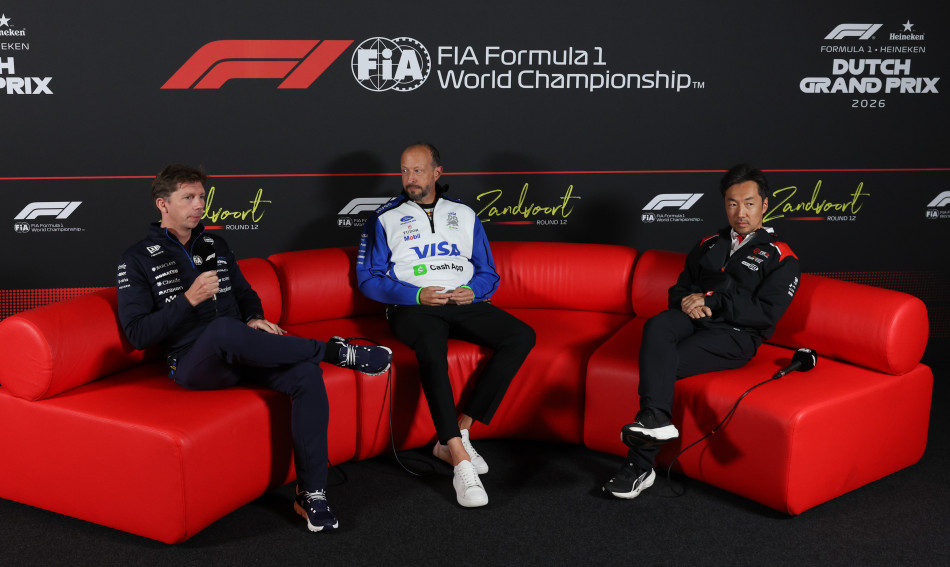
TEAM REPRESENTATIVES
James VOWLES (Williams), Peter BAYER (Racing Bulls), Ayao KOMATSU (Haas)
Q: James, if we could start with you, and can we start by talking about drivers? Both have re-signed. Just how important is that stability for you and the team?
James VOWLES: Yeah, it’s vitally important. When you’re going through what we’re doing at the moment, which is large transformations, large swathes of big changes, the stability that Carlos and Alex provide is huge. Alex has obviously been there since ’22. He wants this project to be successful, but having Carlos there by our side as we go through that is vitally important. It shows everyone in the outside world. We give them, obviously, an inside scoop as to what we’re doing, what was going wrong, how we fix it, but I think it clearly demonstrates to the world that their belief in the project is still there. It’s been a difficult year, but it’s good in the long term.
Q: Now, to quote Niki Lauda, “You learn more when you lose than when you win.” What have you learned about those two drivers during this difficult ’26?
JV: If I start with Carlos, he is immensely good. His attitude and approach doesn’t change irrespective of whether he’s fighting for 18th or a podium, and that’s quite unique. Normally, you’ll see a change in persona from individuals. The more frustrated they are, the more emotion kicks into it, and Carlos doesn’t have that at all. He’s just driven by constant performance improvements. Fundamentally, that is what you need to be driving yourselves forward with. Alex, he’s obviously been here for a long time. What he’s able to bring is he’s able to see how the team was three years ago, for example, and actually paints a really good colour and light as to, even when everyone’s mood is a little bit more downbeat, it becomes harder to become more upbeat as you drop down the grid, he’s able to demonstrate how those changes have a material impact. So, they bring different aspects to it, but both are a strength.
Q: Okay, so both drivers re-signed. You’ve done a lot of hires as well, and can we talk about Piers Thynne, because he’s just started at the team. How is he settling in? What kind of an impact are you expecting him to have?
JV: Yeah, Piers is fantastic. I mean, he knows what a championship looks like. He’s won two championships in the last few years and he understands everything from whether we’re talking from the very start of a concept all the way through to the delivery of products. So, whilst he’s here effectively acting as our in F1 terms, COO, looking after the production, he’s in a far bigger role than that, allowing us to really start accelerating our processes. We’re behind, there’s no doubt about it. The cost cap is a great thing, but it’s also locked in 20 years’ worth of underinvestment. What Piers is able to do is to give us areas where we can definitely move forward at a much higher pace than we were before.
Q: And in terms of 2026 versus 2027, where are you in the factory at the moment?
JV: The main element we’re working on is some new chassis that will come in this year, which will carry over into next year, so effectively a transition point. But what’s really important in that is not the chassis themselves. The challenge of the business was innovation. It should be done in a completely different way that’s never been done before, that has material output, which can be cost, time and weight. In fact, it’s all three in this circumstance, and it’s sort of a class-leading project to demonstrate that whilst we are where we are on the grid, and it’s not where we want to be, we will still keep pushing these innovation boundaries throughout. So that work is ongoing. It will come in this year, as a result of it, we’ve still got a little bit more performance to add, but it won’t make a material impact. When we look at where the grid is right now, we are too far away. So a lot of our focus is really going into next year, especially since there is a power unit change and an aerodynamic regulation change, in order to sort of get back onto, let’s say, a solid foundation.
Q: James, thank you very much for that. Peter, if we could come to you now, and we will start with drivers as well. Can you give us a chronology, first of all? When were you first informed of Isack Hadjar’s wrist injury and the changes that needed to happen as a result?
Peter BAYER: Yes, good afternoon, everyone. Look, it was late last week when I learned about the injury. Then, obviously, the phone started ringing, a couple of phone calls, and then Tuesday the decision was taken on how we will go into this weekend. In terms of changes, honestly, I think as much as we do not like these things to happen, once it happens, we know what to do. You follow sort of the ‘check book’, I guess. The biggest change really was for Yuki’s travel plans, to get him back from Greece and into the simulator, to give him the biggest support we can.
Q: It’s a big ask for Yuki, isn’t it, because he hasn’t driven a 2026 car. What advice have you guys given him coming into the weekend?
PB: Yeah, that’s true. On the other hand, Yuki, for him, it was a bit of a homecoming. He knows the team, he knows the mechanics, he knew his way around the garage, and he’s been keeping himself fit. Honestly, physically, mentally, he’s very well prepared. He has done a couple of TPCs. And so, in terms of advice, I guess what I said to him last night is, “Look, I know a Sprint weekend usually is very busy and hectic, but for you it could actually be an advantage because, you know, focus on the Saturday, Sunday sessions. You have a free practice, you have a qualifying simulation and you have a couple of race laps. That will help you to get into the right mindset and get used to the car.” And he’s done a very solid job in FP1.
Q: And was Liam very keen to get back in the Red Bull, show what he could do?
PB: Yeah, all the boys are Red Bull drivers, and so in the end for them to get into a car that’s faster, that’s made to fight with the other top teams, is always an interesting opportunity. I guess it’s part of our job as Racing Bulls. We’re the biggest talent incubator on the grid. We’ve developed more than 20 drivers over the years, and so they’re ready. I think he will enjoy that as much as Yuki does to be back in the car.
Q: Were there any conversations about Arvid replacing Isack at Red Bull?
PB: No. Look, he’s still in his rookie season. He’s never driven around here and we really want him to focus on his career performance. So no, that was not a discussion.
Q: And just looking further ahead, well, we heard about Max Verstappen’s renewal yesterday. When have you got news for us about your 2027 line-up?
PB: Yes, great news on Max, honestly, because that’s obviously calming the whole system down. And at the same time, we are very happy with both Liam and Arvid and the job they’re doing. So we’re not in a rush. We have a good pool of drivers coming up through the junior programme. So I guess Alan really wants to keep everyone calm, everyone focused, and he will decide when the perfect moment is to inform the drivers and everyone here.
Q: Okay, Peter, thank you very much for that. Ayao, if we could come to you. We’ll come to drivers a little bit later. Let’s start, if we could, with the car, because let’s talk about pre-summer break. It was a frustrating run for you guys. Can you just clarify what the issues were/are with the car?
Ayao KOMATSU: Yes. Before coming into this season, this is the biggest regulation change ever, right? So us being the smallest team, we expect that we’re going to really be struggling to keep up with the other big boys on the development race. So we started the season extremely well, much better than anyone can think of, and then from that moment I think that’s the reality. You know, with our constraints, we’re trying to develop the car as fast as possible, but the other guys are putting performance on the car faster than us. That’s the reality. Then, to be fair, honestly, it’s nothing against the guys in the team. They’re doing a fantastic job, they’re working together, and then for us to have a chance to keep up with the other guys, everything has to be perfect, right? Everything. In life, that’s not something you can ask for all the time. So I really do think I need to provide them with better environment, facilitate it, so that they can show what they’re capable of. I’m sure of that. But the good thing is those tough times show the character, right? And then there’s no blame culture. We looked at the problem: what’s the issue, where are we lacking downforce, why the drivability is not great, what are the drivers struggling with? So, we’re all on the same page, trying to fix the issue, trying to put performance on the car. But of course, again, that takes time. Like James said, lots of things we’re putting in place will take time for it to materialise. But we’ve just got to believe in ourselves, the teamwork, support each other, and we’ll get through it like we did the last two years.
Q: So you say it takes time to put the developments on the car. What have you got in the pipeline, and can you give us a race when we can expect to see it?
AK: Yeah, we have some upgrades in our next race in Monza to start off with.
Q: You had a phenomenal run at the end of last year. With those upgrades on the car, is there any chance that we could see you guys getting on a bit of a run like you did late last year?
AK: Look, again, like James said, this year is the first year of a big regulation change, so gaps are much bigger than last year. Last year, I can’t remember how many cars were within one tenth, right? That was great. But this year, that’s not the case. We’re talking about, you know, from our side it’s like two seconds, right? So, it’s huge. It’s not going to be suddenly leaping from where we are to suddenly challenging in a top-eight position, but it’s incremental changes. We’ve got to prove to ourselves that we can solve these issues together, that we can identify and solve it, because that gives us the confidence to go into next year. I believe you’ve got to face what’s in front of you. You cannot just say, “Okay, this year we can’t do it anymore, let’s focus on next year.” Then you haven’t solved anything, you haven’t proved yourself anything. So that’s what we’re focused on.
Q: So talking of next year, can we talk about drivers now? When will you have some news?
AK: We can’t talk about that. I’m not sure if I’ve got any answers!
Q: Is it imminent? Any idea when we will know?
AK: No, not really. We’re not in any rush. We’re focused on our two drivers, Ollie and Esteban, trying to get the best out of them. They’ve got the tough challenge, right? You know what they are capable of. You know, Ollie hasd showed it repeatedly, Esteban, when he is happy with the car, you know what he can do. So we need to really just focus on providing them with the best possible car, best set-up adaptation, and get the best out of them. And then both of our drivers are fully focused. So at the moment, we’re focused on that.
Q: Final one from me. I’d just like to ask you about a quote from your predecessor, Günther Steiner, who said recently that he thinks Gene Haas has lost interest in Formula 1. Have you seen any evidence of that?
AK: No. I mean, he’s been to every single European race this year. The only European race he’s not coming to is actually this one. So, he’s coming to Monza, Madrid, and then, yeah, so I haven’t. I don’t think I’ve seen Gene at so many races. And he’s coming to, obviously, American races as well. No, he’s just a very, very enthusiastic guy. Sometimes his expectation is very, very high, but it’s good. I mean, he gets frustrated because he’s so focused on the result. You know, thinks I always should be doing better. Yes, I know, Gene, we’re trying. But he’s very, very engaged, focused. He’s very, very passionate. No, no, it’s the opposite. I’ve never seen him at so many races.
QUESTIONS FROM THE FLOOR
Q: (Oliver Jensen – Web.de) A question to James. Can you tell me what is the main problem in this season, and what do you think is possible in the next year, in the next couple of three, four, five years? Do you think it’s possible to fight for a championship in the next five or six years?
JV: The problems this year are the following. Ayao, said it, but this the largest regulation — I’ve been in this for 26 years — this is by far the largest regulation change we’ve ever done, and it exposed the teams that haven’t got all of the systems and fundamentals in the right place more than ever before. I mean, you can see in a sustained arena, teams ended up being within, I think, half a second, pretty much all of us. But when you start now having to explore much wider bases, much more complex cars, and big challenges for us, our first problem was the car was very heavy. Ultimately, weight is an output when you start running out of time, just to be very clear about it. Second is we couldn’t produce it on time and to budget. A lot of that is experience, knowledge, systems and processes that go underneath it. It’s not a lack of work. I have to say that there are individuals that, up until the August break, had been working six or seven-day weeks and 16-hour days. It’s not a lack of passion and dedication, but it is definitely efficiency on output from where we are, and we have to fix that to get better. That then has a carry-on effect. We’ve spoken about it fairly openly, but the car we had in Miami was in reality the car that was due in Melbourne. The car that we had in Miami was actually still in our wind tunnel, in November, and you’re comparing it to cars up and down the field that are much more advanced than that. So, we’ve fallen behind in that regard, and we’re still playing catch-up from what was this winter, which is painful and frustrating. Answering your second question: Step one of this, I suspect next year will be easier simply because a lot of it is carry-over. We can see the regulation set, the chassis. We’re going to do the chassis in the year that will carry over. That will take a lot of load out of the system. But we’re still having a regulation change, and my biggest question will be: is every regulation change just going to benefit the teams that have very established systems, so you see a widening of the gap? And it makes it hard to answer your question on championship because we have to get on top of that first. What I define as good within our organisation is when you put a large change in input in, we’re not falling behind relative to others. In fact, we’re coming up with ideas that others aren’t at the moment. And that’s simply not the reality behind Williams today. I suspect within the next two to three years, we have some very good people that have joined — Piers was a good example of it, he’s not the only one — we’ll actually start to be able to produce a car on time, to budget, to the specification required, and our development rate should be at the right level. But all of the other teams are going to be moving forward as well. So, within the end of your timeline, I hope that Williams is recognised as a severe threat for that, but I think it’s just far too early to be talking about championship. Let’s fix our first problems now.
Q: (Adam Cooper – Adam Cooper F1) For all three of you, we still don’t have any clarity about the end-of-season Middle East races. How much does that complicate things in terms of balancing the budget cap, power unit usage, planning sea freight and so on? And would you be happy to race in Imola in December? Any concerns about the weather there? Obviously, Peter might have some local knowledge.
JV: I’ll kick off, if you like. It’s not a cost-cap issue per se. I think net it’s probably zero, or maybe even help you depending on where you are in attrition. Young drivers is a bit of an issue. A lot of people have planned to do their young driver day in Abu Dhabi, and should that not exist, we’re going to have to make some plan changes as a result of it. I think if it were to be Imola — and to be clear, that isn’t confirmed or otherwise — the weather will be interesting and spicy, but it would still be nice to go back to a European race at the end of it. I know F1 are working incredibly hard for that not to happen and for the calendar to continue as is, but as you would imagine, it’s more than those in this room right now that can determine that.
PB: Yeah, not much to add. I mean, we’re not, again, same thing, we’re not in a rush to take a decision. I think Stefano and the team do everything they can. I guess the only thing I could add to what James said is that eventually, if we would lose those two races, that would certainly have not an impact on the cost cap, but on the P&L, and that’s something that we would hopefully want to avoid. As much as I love racing in my backyard, I definitely prefer to go to Qatar and Abu Dhabi.
AK: I have nothing to add.
Q: (Thomas Maher – PlanetF1.com) A question for Peter. Peter, we saw Dan Fallows arrive at the team a little bit earlier on this year. Can you talk a little bit about the extent of the impact he’s had on the car’s development this year, his relationship with Tim Goss, and how much impact he’s had on the strength of the development over the course of the last few months?
PB: Yeah, I think what we currently see, and speaking about our on-track performances, really goes down to big investments which we have seen over the last years thanks to our shareholders, our partners, then ultimately to Alan and Tim building a team and a culture that really allows people to work and to push. It’s something that I see every day. There’s no blaming, there’s no BS, and there’s true performance obsession with very clear responsibilities. And Dan integrated extremely well. Honestly, from his background, we had a bit of deficiency on the aerodynamic side. He immediately started to work well with everyone in the team. They’re supplementing each other in a very strong way. And I think it’s difficult to say whether he had an impact on what we see today because we’re having a couple more bits coming over the next races, but he’s been definitely a big and valuable addition to the team.
Q: (Nigel Chiu – Sky Sports) Question to Peter. With Liam and Arvid performing as well as they are this year, is it also a nice problem to have, given Red Bull potentially want to promote Nikola Tsolov, who’s leading the F2 championship? Does that give you a bit of a problem looking at next season?
PB: No, because, look, as I said before, Arvid and Liam are both doing a fantastic job. Liam is, I think, on P9 currently in the drivers’ ranking, and he’s shown great pace in qualifying and in races. Same really goes for Nicolas, who’s doing a really, really good job in Formula 2. We will actually run him next week in the TPC in Imola, just to continue to help prepare him. Ultimately, the driver line-up for next year is a decision for Alan to take, and so he will do the best thing for the team.
Q: (Jack Smith – Motorsport Monday) Question for James. When Carlos signed for the team, we saw in the surprise announcement to everybody in Grove what an impact it had, what morale boost it had. Did you feel then that there was an extra pressure to keep hold of him, not just because of the talent he brings on the track, but also the galvanising effect he has on everybody in the team?
JV: First of all, I would say it’s both. I don’t know if we publicised the Alex one, which we did the day before, but it was a very similar response. It’s a team that’s hurting, there’s no doubt about it. We’re not where we want to be. This is not what we planned for. And so to have the news that two of your leaders are by your side and growing with you and believe in the journey you’re on is incredibly powerful for an organisation, especially when we’re asking what we are of them. So, at first, I would say it’s both. But yes, to your point, both drivers, it isn’t just about what they bring on track, it’s about the leaders they are behind the scenes. And an example of that is when this winter went pretty poor, both flew to the UK and spent time with the team to effectively just support them in every way that they could do, which is unusual, let’s put it that way, but it’s an indication of who they are as characters.
Q: (Jon Noble – The Race) With V8s coming for 2031 at the latest and a push to reduce car weight, the topic of refuelling has come back on the table. What do each of you think about the idea of bringing refuelling back? Is it more entertaining despite the costs and safety element?
AK: I’m personally not a big fan of refuelling, really. I mean, I’m not. Did I say I am? Okay, no. I’m not. Even when I was watching from outside, refuelling, it’s just that the race was so difficult to understand as a spectator sitting on the stand, and also in terms of qualifying, etcetera. I’m fond of a qualifying car being the lightest, driver going for everything. So, yeah, in short, I’m not fond of refuelling, and also the weight and cost and everything. I’m not a big fan.
PB: I remember when I was still working with the FIA, we had a work group with Formula 1, with Ross Brawn, back in the days, and his team, about how to improve the entertainment, the spectacle. And one of the big ideas of some people was refuelling, and we were digging very deep into historic footage, data that we had, and it showed that other than a couple of very spectacular and dangerous images, refuelling has not done really anything for the sport because most of the overtaking suddenly took place in the pit lane. And so, I wouldn’t be a big fan of that because it’s proven that it actually doesn’t add a lot to the spectacle.
JV: Similar view. Very personal one is it’s quite warm wearing a race suit when you’re on the pit wall, so I prefer not to do that again. But also, what would happen is we could fundamentally predict exactly where the car is going to stop. You’re always going to take the car right to the end of its fuel load because that’s when it’s its fastest, which now means you can predict what’s going to happen, whether someone’s on a two or three or one, it doesn’t matter. And actually nowadays, with the exposure to the outside world, everyone will start getting that information. It actually takes quite a bit of the intrigue out of it for me. I think the concept behind it is more, “Let’s keep the car mass low.” Completely in support of that. I think going back to refuelling is not the right solution for it, however.
Q: (Leonid Kliuev – GrandePremio.br) A question for Peter. There’s now a lot of pressure on Yuki’s shoulders. He said yesterday that he was on vacation at the beach when he found out, and now all the attention is all on him, media responsibilities and a car that he doesn’t really know. What steps are you taking to reduce that pressure? And on the other hand, what is the goal? Are points a realistic possibility?
PB: Yeah, I think any racing driver is craving to sit in a Formula 1 car, and they’re trained since they are kids to deal with and manage pressure, so I’m not too worried about that. From our perspective, what I said before, we already took some pressure out of the weekend by saying, “Focus on the main qualifying, on the race. See the other bits as FP1, 2, 3.” I know Alex and the comms team, they’re trying to keep his other obligations to an absolute bare minimum. The social media team had to accept 10 minutes instead of half an hour. And for the rest of it, I think that for him I would rather see the big opportunity than the pressure, because he wants to be in Formula 1, he wants to show the world that he can do it. Honestly, if he continues to build, as we said, he has a car that’s capable of running into the points. Whether it’s possible or not, we’ll see on Sunday.
Q: (Dan Lloyd – Racecar Engineering) Question for James. How big a departure will the new chassis be to what you started the current season with? Okay, it will be lighter, but have you sort of taken the opportunity to overhaul the aero, the packaging, to get to where you need to be?
James VOWLES: It sets us up well for next year, is probably the right way of putting it. But it can, much as what happened actually between ’24 and ’25, there’s quite a bit you can do. The chassis isn’t as vital in that regard, in the aero platform, as you would have thought these days. So there’s some modularity into it, is probably the right way of putting it.
Q: (Stijn Keuris – Panorama) Also a question for James. We have the F1 Academy with us this weekend, and I think your team has a great example in Jamie Chadwick of a female driver being able to achieve a professional racing career. On the other hand, I believe the numbers say that still girls are twice as likely than boys to drop out of racing in the first five years after starting. Do you think that your team, with the example that you have in Jamie, or maybe F1 in general, can help these girls in maybe closing that gap and stay longer in the development pipeline to actually reach a level that they can achieve something?
JV: I mean, short answer, yes. So I love F1 Academy, and well done to Susie and everyone else for it, but we are also investing in young karters, female young karters. Sara was one of the examples of that, and proper investment as well, because what’s really missing — you’re right, some drop out, some honestly are not where they need to be on the talent, there’s others that have the strength behind it, but the funding isn’t always behind it. So whilst F1 Academy is important to me, that’s just the beacon. What’s really important is that grassroots investment into young talent. What’s missing is, it’s like anything, the pipeline. If we just took male racing drivers, the pipeline is the only ones that make it up into Formula 1 are pretty much multiple European, world karting champions, then win normally in their rookie, or at least the bare minimum of their second year in Formula 4. And the point from that point onwards is they’re multiple world champions. That’s how you get into Formula One. But the pipeline is tens of thousands of individuals that you choose from. So, the bigger the amount of individuals that are available to you, the higher the probability of choosing the talent. And so, our responsibility in that is to go in and try and improve that pipeline and find talent and invest in them.
ENDS
 Facebook
 Twitter


