F1 - 2026 Chinese Grand Prix - Friday Press Conference Transcript
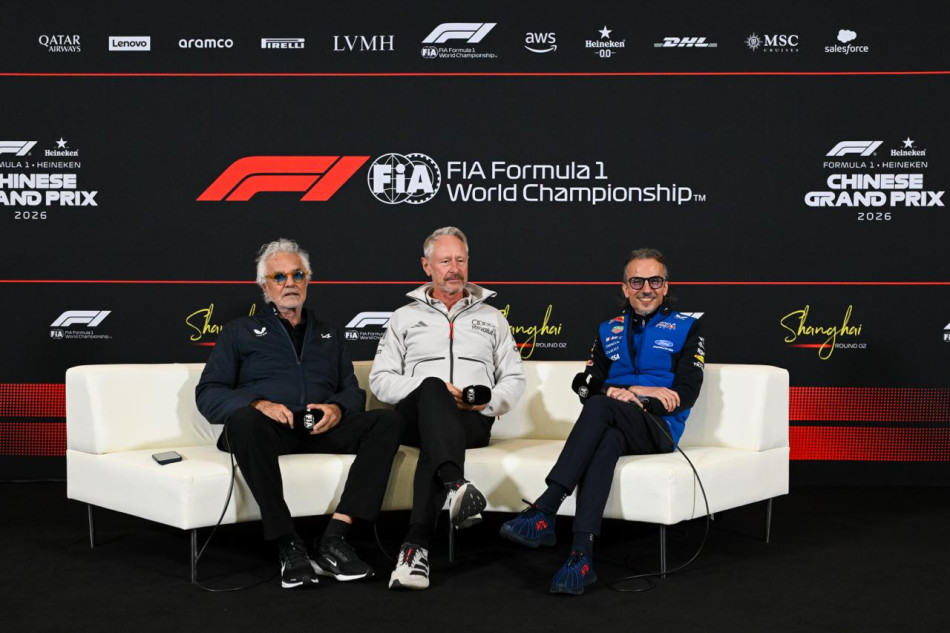
TEAM REPRESENTATIVES: Flavio BRIATORE (Alpine), Jonathan WHEATLEY (Audi), Laurent MEKIES (Red Bull)
Q: Laurent, we’ll start with you. Race one done, what were the biggest learnings for Red Bull in Australia? Let’s start with that.
Laurent MEKIES: Depends how long do you have? Seriously, many, many learnings. Obviously, I think if we want to think what have been the biggest aspects for us, it’s probably the power unit, being so new in the adventure. But it’s fair to say that the learnings were 360 through the weekend. You have seen through qualifying sessions how much every driver and car were adapting. In the race, how much we were all learning about how to deal with our energy. So, I would say, to answer your question, first the power unit, on our side, in real-life race trim. Second, probably how we all learned to deal with energy management around the lap throughout the race weekend.
Q: Max said yesterday in the press conference that P5 was the maximum he could have got in that race, irrespective of where he’d started the Grand Prix. So, where are Mercedes and Ferrari faster than you at the minute?
LM: At first, to Max’s assessment, I think it’s what we said after the pre-season testing. We said we felt we are around the fourth team. If anything, it was a touch better in Melbourne. So yeah, the gap to Ferrari and Mercedes is substantial. It’s probably half in the straight, half in the corner. There is not one single area that we need to improve. It’s a 360 improvement. It’s not a surprise. It’s going to be a development race. It’s going to be a learning race. So, there is not one single area that we pinpoint in terms of gap to competition, but it’s going to be a full effort from all departments.
Q: What did we learn this morning in FP1? Do you think the gap will be similar here in Shanghai?
LM: If anything it looked bigger this morning, but it’s early days. The Sprint weekends are very, very long, but certainly the gap to Mercedes and Ferrari is large. So, we know we have work to do, and this weekend will be also a big chance to learn.
Q: Quick word on both of the drivers. Max first, can we get your thoughts on him doing the Nürburgring 24 Hour race? Just how much convincing did you need to let him do that?
LM: He doesn’t need to convince us, really. It’s enough to speak a few minutes with Max and you see his face lighten, his eyes lighten when he talks about racing cars. It doesn’t matter what type of cars. It’s great. We have seen it last year. He has done it quite a few times in between the races. You would think it’s taking energy from him, but in fact he comes back with more energy to the racetrack. He is in love with the sport, and it’s a great reminder to all of us that we are all motor sport fans. He’s a motor sport fan and he loves spending his free weekends racing.
Q: Tell us about the impression that Isack Hadjar has made on the team so far this year.
LM: He did a near-perfect first weekend, and I’m sure there was enough pressure on him to make that a difficult achievement, but he did a near-perfect race weekend. Friday was very good, very good learnings, very good set-up scan that we could split across the cars. Qualifying, we lost Max very early on, obviously, and at that stage all eyes were on him. He could have been more conservative, he could have been too aggressive, but he just nailed it, put the car in P3, out-qualified both Mercedes and Ferrari, which was probably a touch better than what we would have hoped for where we are now with the car. In the race, he was part of the first few laps dramas, with management and the fights with all the cars around, and until we had the issue with the engine he really did the perfect weekend. So, we just want more of that.
Q: Jonathan, let’s come to you now. Can we just throw it back to Melbourne first of all, because Sunday was both good and bad for Audi. What was your overriding emotion after the race?
Jonathan WHEATLEY: I think overall it was a feeling of pride in what we’d achieved in really the 11 months since I’ve been with the team. There’s always that feeling of yin and yang for a team principal when one of your drivers doesn’t get a chance to participate, even in the race. I really felt for Nico. He put so much effort in over the winter. He came back reinvigorated this year and he was fully focused. He’s been working hard with the engineers, and just to see his race not even start was very difficult. Then on the other side, to score points in the very first race as the Audi Revolut Formula One Team, extraordinary. Not just a technical achievement, the R26 under Mattia Binotto, Stefan Dreyer and James Key, to bring together this first ever Audi Formula 1 car. Then every single part of our trackside appearance is new: new team clothing, new hospitality, every single bit of pit equipment is new, the garage. What’s been achieved in such a short period of time has been nothing short of incredible. On top of that, I have to say the partners that we signed, some of them as early as just a few weeks before the first race. I think overall, pride in what we’ve achieved, but we’re very, very focused on just how far we’ve got to go.
Q: Let’s talk about that journey in terms of how far you’ve got to go. In terms of performance, how close were you to maximizing what you had in Melbourne?
JW: I don’t think I’ve ever left a race weekend with the engineers telling me we got absolutely everything out of the car. I think our focus in Melbourne was to execute a clean race weekend, focus on ourselves, not get too caught up in the noise, not get too distracted with what other teams were doing. I think it’s becoming more and more clear to us, the picture evolving over time, where the areas of performance are that we can add to the car. It won’t come as a surprise to anyone, it’s a brand new chassis, brand new power unit, and we’ve got some areas to make up. Especially our focus at the moment is on the powertrain development. That’s clearly one of the areas that we’ve identified in data that is somewhere, as you would understand, that there’s some performance to be found.
Q: What about Gabriel Bortoleto now? He commented yesterday in the press conference that he’s feeling much more comfortable coming into year two. Just how much change, how much development, have you seen in him coming into this season compared to 12 months ago?
JW: Firstly, I’ve been encouraged with both drivers over the winter – recharging, coming back fully focused and absolutely embedded with their engineers, looking at every single area where you can get performance out of the team and out of the car. I think with Gabi, again, he showed his work ethic. He’s been embedded in Switzerland and Neuburg over the course of the winter. He’s either been on the chassis simulator or the PU simulator. He’s growing as an individual, he’s getting more confident, he’s understanding what’s important rather than getting caught up in the noise. I’m tremendously encouraged by his progress and also his ability to knit a team around him. Also, he was here cleaning wheels on Wednesday!
Q: Flavio, if we could come to you now. At this early stage in the season there’s so much talk about performance and potential. Just what did you make of Alpine’s performance at the season-opening Australian Grand Prix?
Flavio BRIATORE: I know. So I think I’m pretty… we are not happy at all. Our performance was very weak and was a combination of different factors, and we know what is the major problem we have in the car. We try to resolve this as quick as possible. But for the rest, it was the first race and for a long time we have no point in the race in Formula 1. At least we have one point with Pierre. It happened, it’s already passed, it’s impossible to change the result.
Q: Flavio, you say you’re not happy with the performance. What goals have you set Alpine this year?
FB: To finish in front of him [Wheatley], if it is possible! Close to him [Mekies], if it’s possible! This is what we’re looking for. We’re looking to be P7, P8, P6, this range, this range of the competition we have. We have the top four top teams, including Laurent, they are very, very strong, and after that is all the rest. So fighting to be in front of all the rest.
Q: There’s lots of speculation at the minute about potential investors in the team, Christian Horner, Toto Wolff, even Mercedes themselves. What’s the situation? What’s the latest, Flavio, on that?
FB: Every day is a new situation. I don’t know what is the latest one, but what I say is that I know it’s a negotiation with Mercedes, not with Toto, with Mercedes, and we see. In this moment we have three or four potential buyers. Don’t forget, we’re talking about the Otro shares, nothing to do with Alpine. It’s the share owned by this hedge fund, it’s called Otro, American fund. They want to sell the 24 per cent and a few candidates are ready to do the deal.
Q: Are you tempted to buy in?
FB: No, no, no, no. Just looking. I’m just looking what’s going on and just watching what’s going on. For us, we have no communication with Toto in this moment. So, if somebody buys the shares, we are very happy.
QUESTIONS FROM THE FLOOR
Q: (Craig Slater – Sky Sports) I’ll pick up on the Mercedes potential to buy into Alpine perhaps, Flavio. Could you guarantee if they bought that stake they would have no influence on how the team operated, or indeed voted in areas like the F1 Commission and so on? And perhaps to Jonathan, would you have any concerns about Mercedes having a stake in another team? Obviously Red Bull historically have had the two-team interest.
FB: Red Bull already is a pioneer in this in the last 10 years or 15 years, whatever. Like I tell you, Mercedes, one group is looking to buy Otro’s 24 per cent. Normally one company, 75 per cent decide and the 25 per cent is a passenger, and this is the reality. I don’t know if Jonathan is happy or not. Tell your opinion.
JW: I’m very happy.
FB: Great. This is fantastic.
JW: Look, the sport has very, very clear governance. I don’t see any conflict of interest or concerns on our side at all. To be honest, I’m just watching it, eating the popcorn and enjoying the show.
FB: Yeah, make sure they have popcorn.
Q: (Mara Sangiorgio – Sky Sports Italy) A question to all three of you. As competitors, are you worried about the gap Mercedes started with, and not just this weekend, in general, considering the general picture?
LM: I’m not sure if worried is the right word. It’s large, no question. It didn’t really come as a surprise. Somehow, we were expecting them to be very, very strong as the pre-season test built up, even though it was not immediately visible at the test. So, not a surprise that it’s large. On the other hand, we expect the season to be very long. We expect the development rate to be much higher than what we have seen in the past. Of course, it’s always going to be difficult to get a second back, because obviously they will improve as well, but nobody is giving up here and yeah, that is the fight we are in.
JW: Look, they’ve done a great job and they’ve showed us what is possible, what’s achievable at the moment, and we’re focused on our own performance at the moment, honestly, internally. At some point we’re going to be looking up the road and we’re going to be learning. As a PU manufacturer, we only have two cars with an Audi PU in them. Mercedes have eight cars. They’re learning at a much faster rate as well, so we’re not underestimating the challenge we have ahead of us. As I said, they’ve done a good job and our job is to catch up.
FB: The same, so many years we see Red Bull with the same situation. For many years it was Red Bull first, one-two, second, first. We need learn, we need learn and try to do better, and congratulations, honestly, they’ve done a better job. This is the reality. But it happened already with Red Bull for many years and now it has happened with Mercedes. I hope we be strong enough from now to the end of the season to be closer to Mercedes. This is our motivation, and we need to be learning from these people, they’ve done a super job.
Q: (Ted Kravitz – Sky Sports F1) Ahead of any meetings with Formula 1 and the FIA about the new regulations, could you each maybe give us an idea of any ideas or areas that you’d like to see for potential consideration for future races? Thanks.
LM: The truth is we are having super open discussions. We met with the teams, with the FIA, with F1, just before the season started. It was in Bahrain. We just said, look, let’s do these first races, let’s see what we are getting. If there is a need for adjustment, I think there will be all the willingness in the world across the grid to adjust for the benefit of the sport. It’s early days, it’s been only one race, even if it’s been a few surprises in the race. I think that’s what we’ll do. We’ll probably regroup again after China and discuss what adjustments are needed short term, mid-term and long term.
JW: I totally agree. I think I’d add to that that every single time we’ve come to a new circuit, it’s exposed again other areas in the car where there’s performance deficit, where you have to tune the car differently. It’s a world championship. I think we’ve got to keep a steady hand on the tiller and the FIA are doing that at the moment. It’s been encouraging, the amount of conversation there is, the open discussion between teams and the FIA as to how to manage this set of technical regulations. I can’t emphasize again just what an ambitious set of technical regulations this is and how complicated these cars are to manage. So, I think it’s a case of just trying to keep everything under control at the moment and just see how it develops over time.
FB: It’s very early stage to have a final judgment. I agree completely with Laurent and Jonathan. We need to just see the situation, and there are always conversations with FIA, with the teams, and [we try to] find the best solution for the sport, find the best solution for the teams and for the spectator. Now we are very, very early stage for to have a strong judgment. We don’t have it, basically. Just let’s see.
Q: (Gustav Theile – Frankfurter Allgemeine Zeitung) First to all of you, China is the biggest car market in the world and F1 is the biggest car racing series, yet the popularity of F1 doesn’t really translate into sales in China for none of the brands that are active in Formula 1. Why is that and how do you think this could change? And the second one for Flavio, is there any Chinese interest from investors in your team?
FB: With this, for me, I just had already [answered] two minutes ago. Was there two minutes ago? Okay, I just tell two minutes ago what’s going on.
Q: Flavio, your thoughts on sales in China and impact on the Chinese market?
FB: I don’t know the Chinese market in China, honestly. I know it’s pretty much depressed for everybody! But I don’t know really in China what’s going on. Honestly, I don’t have any idea what’s going on in China regarding the manufacturers, if it’s good or bad, I don’t know. Honestly, I know about the team, what can we do in China. I don’t know about the manufacturing, what they do in China. Maybe Jonathan has [knowledge] of manufacturing, [he is] much more precise.
JW: It’s on me. I think what I’d say first of all, China is important for Formula 1, so let’s just tackle that first of all. We’ve been racing here since 2004. I’ve been at every race here bar one. It’s an incredible place to come and visit, so much rich history and culture here, fantastic. The fans here are amazing and the teams enjoy being here. Actually, you look at the facility that we’re in, you look at the vision there was in the creation of this, you know, it’s swallowed up an 11-team this paddock, and it still feels absolutely like there’s loads of space. So, it’s exciting to be in China racing, and I think for manufacturers it’s important. Formula 1 brings brand awareness over and above everything else. I think the two of them are absolutely deeply connected.
LM: Maybe just to add on what Flavio and Jonathan said, one thing is very, very visible, is the fans, the Chinese fans, the fan base increased dramatically in the last few years, in the same way that we have seen it increase dramatically in the rest of the world. When we came back here after COVID, it’s a completely different game. We see the full grandstand, we see the younger fans, we see the more gender balance as well, female/male, in the audience. So, we see all this incredible increase of interest for Formula 1 that we have seen in the US or in other countries. We see that also here in China. It’s great to see the fans waiting outside of the circuit early in the morning and late at night. I think it’s probably only the beginning of Formula 1 falling in love with China, China falling in love with Formula 1, and we have started to see that again in the last few years and it’s quite impressive how it’s increasing year on year.
Q: (Sàndor Mészáros – RacingNews365) This is for Laurent and Jonathan. You are racing with a brand new engine this year. That is obviously a massive challenge. How is possible to explain the progress? Can you please explain a bit more about it and what can be the next steps in this area?
LM: To your question, the first thing is to give incredible credit to everyone back in Milton Keynes. Three, four years ago it was a field at the back of the race team, now it’s complete PU operations. We went to Melbourne and we barely talked about the PU, and it’s easy to forget that it was the very first time that we ran with the Red Bull Ford Powertrains. So, an incredible achievement. The fact that we forget about it is a good sign. It means that the next minute you want more, you look at the gap to the guys in front. But for sure what has been achieved there by everyone in Milton Keynes is historical. I think they have set a new benchmark. Again, credit to everyone that was back there three, four years ago, from day one, to build that from the ground up.
JW: I think, again, just to echo Laurent’s comments, for Audi it shows the ambition of the project. It shows that entering isn’t just a brand choice. It’s an absolutely serious undertaking to become a chassis and power unit manufacturer in Formula 1. What we’ve achieved, what the team has achieved in Neuburg, is nothing short of incredible. The last few months, the amount of work, the effort, the energy that’s gone into this from the team there has been incredible. Their response to the situations we found ourselves in on track and testing, coming up with fixes for that, providing a brand new workforce. We’re trying to integrate a brand new chassis and power unit team all together in one go. With the wide competition in Formula 1, probably aware that you have to homologate your engine, so we’re all fixed at the moment in terms of what we have, in terms of our performance and reliability. There are mechanisms, the FIA have been thinking way down the road on this, there are mechanisms in place to assess that and try to ensure that there’s a level playing field for all competitors and to allow teams to make those different development opportunities if it’s correct, if it’s measured correctly, and at the right time.
Q: (Michael Butterworth – Xinhua News Agency) Flavio, the first time you were in charge at Enstone the team was winning races and championships. What do you think needs to happen before Alpine can think about winning races and championships again?
FB: This is a very hard question. I don’t know. We try doing our best and to improve year by year. But now we have everything to be competitive. We are very happy with the engine we have. We are quite happy about all the team. Sure, we’ve done a lot of changes in the team and we need preparing the base, la pierre triangulaire, to build up the team. It takes a few years, like everybody. We want to win and we’ll see. We’re just working hard and see what happens. But we are very committed, Renault is committed and the team is committed. So we see. We try our best like everybody else.
Q: (Jon Noble – The Race) Jonathan, just picking up the point you mentioned about Audi kind of being alone with a power unit. How much harder has that made that challenge in the build-up to this season? How much more difficult is it going to make nailing these regulations during this year? And do you think in the shorter term rather than longer term, adding a customer would bring benefits in fast-tracking progress?
JW: I think, first of all, to tackle the customer question, I think we’re a long way away from being able to support a customer at the moment. But look, we have to be realistic. If you look at the mileages that Mercedes engine teams accrued over the winter testing, it’s something like four times the amount that we were able to, and we had a reliable programme, we still did a lot of mileage. So, they’re learning at a greater rate as well, so we have to be realistic about that. But then also, it’s early days in the project. We’ve talked about it for some time, that our ambition at the moment is to be a challenger and to move from challenger to competitive at the right time. In terms of the power unit, it’s incredibly complicated. It’s a bold ambition on behalf of Audi to show what they’re capable of in Formula 1. I’m sat next to Laurent, and he’s under no illusions about the challenge either. To make a modern power unit in Formula 1 is incredibly challenging, exciting, and the technology that we’re learning, we’re learning at such a rate, it’s incredible. So, it’s going to be interesting to see how the power units develop over the next few years and in the short term over the next few months.
Q: (Tim Kraaij – GPblog.com). A lot of the drivers yesterday said that it’s waiting for a crash, a big crash, to happen during these start procedures. Are there any changes necessary to how the rules are at this moment? And how difficult is it to get everyone aligned on making changes at the moment, especially when there are some teams that maybe benefit from how the current rules are set?
LM: I guess the start in Melbourne and the very first laps in Melbourne brought a fair share of surprises to all of us. We are part of the ones that probably had quite a bit of a low battery on both cars at the race start. But it is what it is. There are constraints, the regulations are the same for everyone, we will all learn how to deal better with it. Yes, it means a fair amount of complexity for the drivers, and you may argue whether it is unnecessary complexity or not in this sort of formation lap scenario, but I’m sure we’ll all progress and learn how to deal with it better and better.
JW: I think in terms of the load on the driver, this is the interesting thing. There’s so much to manage on a formation lap. It’s far from just driving around and then forming up on the grid to do a start. You’ve got tyres in the right window, you’ve got to get your brakes in the right window, you’ve got to get your energy management in the right window, and by and large drivers learn really fast, teams learn really fast. There were some takeaways. The FIA is still working on the starting procedure. There will be some small changes to that this weekend as well, which I think should alleviate matters. Again, as a sport we learn really, really fast. I think it’s really important to keep an eye on, keep a steady hand on the wheel when it comes to doing anything knee-jerk in terms of reactions.
FB: The driver… I mean, the start, I think for the driver it’s different, a different procedure to start the race, etcetera, like Jonathan said, Laurent said. We learn. We are in the learning curve. We have only one race for the moment and sure, for the driver it’s a big change. You need thinking about more, you need to be preparing yourself in better way, and it is really different than before. Now, what we need to do, as Laurent said, we need to work in the safety area. If it’s something we need to modify with the FIA and with the engineers, and we’re talking all the time, and if we find something is wrong, we believe it’s wrong, if it is a danger for the driver, sure, something needs to be changed. For the moment, for the driver, it’s a different job. The start is a completely different aspect than last year, the year before.
Q: (Adam Cooper – Adam Cooper F1) I’m fine for all three of you. How important is it to get clarity on Bahrain and Jeddah sooner rather than later? I’m thinking obviously the logistical challenges you face, but also things like upgrade production schedules. You’re designing and building bits that you want to use in Bahrain that maybe you won’t need until Miami. Obviously, you need to adjust around that. So how long can you wait for an answer, basically?
JW: I think we follow the guidance of the FIA and Formula 1, as we always do. They’ve always led us in the right direction. Nobody’s going to compromise on anything that would put teams into an uncomfortable situation. We’re all so capable of… One of the biggest sides of the business is the logistics side to it, not just parts but also people moving it around the world. Teams are so good at that. It’s just a bump in the road if something were to happen in that respect, you would just deal with it. I don’t see any real issues, to be honest.
FB: Completely agree with what Jonathan says.
ENDS
 Facebook
 Twitter