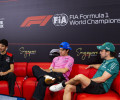
F1 - 2026 Barcelona-Catalunya Grand Prix - Friday Press Conference Transcript

TEAM REPRESENTATIVES
Mattia BINOTTO (Audi), Toto WOLFF (Mercedes), Ayao KOMATSU (Haas)
Q: If we could start with a question to all of you. From what we hear, all three of your teams will get some additional development and upgrade opportunities. Just how valuable will that be? Mattia, perhaps we could start with you.
MB: For Audi it will be a significant benefit. I think it's what we were expecting. Since the very start of the season, we knew that most of our gap to the top teams was on the power unit side. Not a surprise to us. Hard work will be required. We've got plans, but it will be beneficial, but not in the short term. Often maybe people may believe that once you've got ADUO, maybe the race after you may introduce 10 kilowatts. That's not what will happen. In our case, we are looking for a big development, but more on the medium and long term. We are focusing our efforts more on the medium and the long term again, and the ADUO will be beneficial in that respect. So ADU means more budget cap, means more dyno hours, more freedom on development. But again, not everything sometimes is in the short term. Our journey is a long journey. We have set an objective by 2030. So as well, when it comes to car development, power unit development, especially the power units, it takes time to develop, longer than maybe some chassis parts. Again, our plans are set. We will not see immediate benefits from the ADUO, but then it will be certainly beneficial for us.
Q: Thank you. Toto, Mercedes?
Toto WOLFF: Well, the first thing, I had Flavio calling me and saying the deal was that he’s buying the strongest engine, and he’s found out that it’s not the strongest engine. So, what can I say? Like Mattia said, obviously we’re in a different situation than Audi, but a new homologation is definitely something that is helpful, because if you don’t get that, there is quite a possibility of being leapfrogged by somebody else who is able to do this. We have come with various ideas in the past, but, you know, we shall see how this pans out over the next term, because we must not forget this is not a frozen situation, but it’s going to be looked at every few races and then being judged upon.
Q: Thank you. Ayao, please.
Ayao KOMATSU: Yeah, obviously our situation, not being a PUM, is different to Mattia and Toto, but of course, as a Ferrari PU user, we are very happy that we got those two stages of ADUO. That will of course help us significantly. Of course, regardless of that, we’re pushing every day trying to find more performance on the chassis side, and we work very closely with Ferrari in a very collaborative manner. As and when we get those upgrades, we are just keen, just trying to get on top of it and then make best use of it as soon as possible.
Q: OK, thank you for that. And Mattia, let’s come back to you. We’re back at the racetrack where you ran the car for the first time back in January. Can you just tell us about the development curve you’ve been on with this car since then and the learnings that you’ve made?
Mattia BINOTTO: Yeah, you’re right. We shook down the car here in Barcelona. It was the 9th of January, and that has been the very first day that somehow Audi F1 has hit the track, very early to any other competitors. Winter testing would have started by the end of the month of January. And the reason why we have been so early on track is because, being a new team, somehow brand-new power unit manufacturer, we knew that a lot of the operations, we would have at least the learning curve on the operation, would have been significant. And I think that has been, as a matter of fact, what has happened at the start of the season. The car has developed, the car has improved, but more of that is exploiting the car at the racetrack, making sure that we can have smooth sessions, running properly, finishing the sessions, no reliability issues, no operational issues. And there is so much to gain in that respect as well, in terms of drivers’ confidence, because they can somehow run and learn from the car itself. So, if I look at the start of the season, I think the most we have learned is by us in terms of operations, having improved significantly since that 9th of January. And then, yes, on the car you are trying to develop whatever you can from the aero perspective, from some brand-new regulations, energy management. I think especially on the software calibrations, if I look at our drivability, that’s where I think when the drivers, the first time they drove the car, the most they were shocked about was the drivability, how the car was difficult to drive. The engine was undrivable and the gear change as well. But again, that’s not a surprise for us, for where we were. And today, after now a few months, it’s where maybe we have improved the most, because again it’s all the settings you need, calibrations to make those animals [which are] so difficult to drive as smooth as possible. It’s something for us, it’s a lot to learn and to develop, and I think we are on the right path.
Q: You talk about driver confidence. Just a quick word on Paul Aron this morning in FP1. How impressed were you?
MB: At first, I’m very happy that he could have a smooth session. Last year, whenever he had FP1 with us, it has never been without any problem. So today at least he’s got a good session, and again he has proved that he’s a capable driver. He’s a fast driver. He never tested that car on track. Immediately fast since the very first lap, the very first run. So well deserved from him. Happy that somehow he could show up what he’s capable of, because at the end he’s a great driver and so the rookies need to have an opportunity to show how capable they are.
Q: OK, Mattia, thank you very much for that. Toto, let’s come back to you. Can we throw it back to Monaco? News today that Pierre Gasly’s P3 has been reinstated. Given what happened to George, how has that news been received at Mercedes?
Toto WOLFF: Well, it was a very unfortunate situation, and clearly we can all learn from that because that wasn’t something that just came up on Sunday, that suddenly 10 cars were in breach of pit lane speeding. It’s something that was flagged before. For us as a team, and especially for George, massive implications. He had a difficult qualifying session, but he moved all the way back up there, and clearly without the penalty, without us not serving it correctly, it would have been a totally different outcome for his race. Whether he would have made the podium or just not is a different question, but a different outcome would have had an impact on his championship situation. And that’s why it’s unfortunate. Now we are assessing, as we speak, what the Gasly situation does for George. Obviously there are certain timing restraints. We wouldn’t appeal the Gasly result, certainly, but we would like the FIA to look at what could be the remedies for George’s race. And I don’t think that there is… I think we are having some timing limitations and some other legal constraints, but definitely something to… You know, we have a reason to be annoyed for. And I wish we could have had those conversations before the race on Sunday.
Q: It’s been a frustrating few races for George. How do you assess his recent problems? And as the gap to Kimi grows in the championship, do you worry that he’s starting to tighten up, maybe overthink the problems?
TW: No, I think George is very good in showing resilience. Every racing driver goes through the ups and downs, and particularly when you look at the last handful of races, he could have scored much better results. We wouldn’t talk about George’s difficult campaign if he would have won Montréal or finished second. But the DNF that was caused by the team robbed him of those 25 or 18 points, whatever it would have been, and then we wouldn’t have had this discussion in Monaco. Without the Monaco incidents, he would have scored solid points, and so this list continues and has been somehow the signature of this campaign so far. And on paper, he would have maybe been 50 points further up. He isn’t, and he copes well with that. He’s absolutely on it. This morning’s session at FP1 debrief was very upbeat. He’s come a little bit more back to how he likes the car, and I’m sure he will rebound. I mean, there’s nobody else I would wish to have in the team than the two we have.
Q: OK, thank you for that, Toto. Ayao, let’s come back to you now. Mattia had told us about the journey they’ve been on at Audi since the start of the year. At Haas, you’ve scored top 10s in five of the six races so far. So, tell us about the progress you’ve made with the VF-26.
Ayao KOMATSU: Yeah, I think we started off the season very well, but again, just focusing on the basics. Like Mattia, we really focused on hitting the ground running on day one with reliability, because every time we run the car, we’re learning how to get the most out of the car. Then, of course, with it being the first year of the brand-new regulations, then focus quickly changes to the development championship. And then, of course, we are still the smallest team, but I think our guys are working really well together. When we put the upgrade on in Montréal, we wanted to put it a bit earlier but we couldn’t, so that’s one limitation. But when we put it in Montréal, I think the circuit characteristics and ambient condition, etcetera, that meant that we had a very different challenge, which actually uncovered some of the weakness of the car. Nothing to do with upgrade, actually the fundamental weakness. But again, I think I’m really happy with the reaction we’re seeing from everyone in the team. Whenever we see a new problem, new issues, we really work as a team, stick together, and then the only thing that matters is how to improve from there. So, from the very limited timing between Montréal and Monaco, we made some progress. In Monaco, we were a bit unlucky in qualifying not to get a car up in Q2, then I think we had a chance to get into Q3 at least with one car. But again, I think the Monaco race shows that you should never give up. Starting from P17, we just focused on what we needed to do, then anything can happen. And then as it unfolded, these penalties aside, we managed to finish P9, in the top 10. So that was a great reward for everyone. And here it’s a totally different challenge, so again, we’ve got to adapt very quickly. FP1, we did some test items based on what we learned in Montreal and Monaco, and we just need to keep getting answers, keep running, and then put improvements in place as quickly as possible. So yeah, we started well but there’s no time to relax at all. We really need to be completely on top of our game, produce our best performance, every time we go out there.
Q: You talk about progress, and in the past, quite recently, you’ve spoken about the simulator that is being built in Banbury. What’s the latest on that and how will that accelerate things for you?
AK: Yeah, I think to start off with, it’s a bit funny to talk about simulator being installed in year 11 of a Formula 1 team. If I had the choice, I would have done it much sooner, especially preparing for this regulation, brand new power unit, brand new chassis. Simulator is key, not pre-season but during the race weekend as well. So, I really can’t wait for that to be operational. We should have it just before or around summer shutdown time. Again, that will really transform how we prepare the weekend and through the weekend, and then post-event as well. Again, just as a team, we are just tackling, let’s say if there’s 10 problems we want to tackle, we can’t tackle all of them, so really prioritising and then looking at what is the most efficient thing to tackle. And the simulator is very high on the list. Yeah, I think we are really looking forward to it, and hopefully we should be able to see the benefit of it later in the season.
QUESTIONS FROM THE FLOOR
Q: (Nelson Valkenburg – Viaplay) A question for Toto. You spoke about George’s season. We’re trying to figure out, all of us here in this room, what is happening to Kimi and how he’s developing. Are you surprised by the fact that he has made such a step forward? And from your point of view, what is that step? Where has he improved the most compared to where he was last year as a rookie?
TW: Before I respond to your question, [Ayao] you’re looking forward to having the simulator, it’s only going to confuse you even more! So, progress. I think last year… I’ll say it differently, he was 18. You’re being thrown into this monster called Formula 1 under the magnifying glass of everyone in a team that is capable of winning races, and I think the pressures are enormous. And for me, it was almost like a young man in the headlights, discovering what this was all about. And then came the avalanche of interest and requests when we came back to Europe, and I think that was just too much. And then it’s totally different now to come back, to know how the system functions, what is requested of you, what is it you need for yourself to perform best. We are trying to shield him from media and marketing activities in the way that they protect him and to the best of our ability. We keep emphasising to our friends from the Italian press also, please don’t draw any comparison with Ayrton Senna or ‘Il Fenomeno’, I think Gazzetta titled that he’s won five races in a row, which is unbelievable for a young man, but we haven’t won a championship, and he’s 19. So I think it’s just an experience explanation that I would give it. The talent was always there and that you could see through all of the karting years, the junior formulas, that he was extraordinary, and therefore we just needed to bide our time. And I’ve said it many times last year, we would see moments of brilliance and moments where we would tear our hair out because of the mistakes. And this is exactly how it happened. Now, how he came out of the blocks this year was very exciting but bearing in mind that George had his fair share of bad luck also, and I’m always trying not to reduce Kimi’s achievements, but these two are really, when it comes to pace, when it comes to racing results, they are not far away from each other. They keep challenging each other, which is also good. But it’s just a young man that has understood what the demands are of Formula 1, how to translate his talent into results. But we’re very impressed.
Q: (Craig Slater – Sky Sports) Another one for Toto. George talked after Monaco about maybe the car’s characteristics not quite suiting his driving style. Last year, McLaren maybe had a similar situation with Lando Norris and talked about bringing in a specific part to try and help Lando. Is anything like that on the agenda for you, or is it not as significant an issue with the car and George that needs addressing that way?
TW: I think, George is pretty clear to trace back when it was more difficult. And that is not a car part, but it’s simply settings. In Miami, Kimi was going very well, like last year, and George felt he needed to set the car up mechanically and electronically more in Kimi’s direction, and this is what he kept because obviously Kimi was very fast. And I think it has misled him, and probably also he had to adapt his driving style, and that wasn’t translated into lap time. And he’s just recalibrated, reset, came back to what works for him, and we’ve seen that in FP1 this morning.
Q: (George Ananidas – Ant1 TV) A question for all three. All your engines are getting upgrades based on the ADUO system. Based on what you know until now with the 2026 regulations, where is the part that you may give a little more attention with the first upgrades that you will get from the ADUO?
MB: Yes, I can start. First, the ADUO is made on assessment of engine power, pure engine power, and the delta which is measured is really on the engine itself. So, it’s not the full power unit, it’s not related to energy management, efficiency of the electrical system. It’s pure engine power. So, if you have been assessed that you are down in engine power, I think the first where you have to be concentrated and focused is really on engine power. And that’s certainly where we stand at the moment ourselves as Audi. And that’s down to the efficiency of your combustion chamber. There isn’t much you can gain in there, but that’s not obviously the overall performance of a power unit. There are certainly efficiencies in the batteries, in the inverters, in the turbo dimensioning for what can be drivability on track and compromises. So when developing a power unit there are a lot of metrics, but certainly when it comes to ADUO, I think that’s assessing, as I said, the gap on pure engine power, and that’s, I think, where at least we are focusing the most.
TW: Yeah, it’s internal combustion engine, as Mattia said. And I think it’s quite easy to analyse. You can see how much grunt you have from the ICE, and definitely being behind is a challenge for us. Did we get that wrong? Didn’t we optimise it? Didn’t we optimise it on the ICE side? And how can we do it better? I’m not getting red!
AK: No, obviously my side is a bit different. Of course, we trust Ferrari to come up with a good upgrade on the ICE side. But of course, that will have an impact on our deployment, even though that’s not what you’re changing as a consequence of, let’s say, better ICE. So again, just as a customer team, just need to get on top of using it as best as we can straight away. Can’t wait.
Q: (Jon Noble – The Race) Mattia and Toto, the ADUO ranking caused a bit of surprise in Monaco last weekend, especially putting Red Bull as the benchmark. Do you think the rules and the way the measurements are done are fit for purpose? Are they working? Do they need to change going forwards? Because it’s obviously something that’s going to impact the fight at the front of the field for what was originally a catch-up mechanism for someone who got it wrong.
TW: In my opinion, when you speak to Nikolas, it’s data that they have measured and collected. There’s no political background, there is no favours, but it’s the outcome of their analysis of their torque sensors and the way it’s being done, and that is the result.
MB: Yeah, so as Toto said, I think there is no doubt on the assessment. We’ve got proper sensors on the car to measure the delta power. So, is the principle of the ADUO [being] based on the delta kilowatts the right approach? We may argue. There is an ADUO as well for the chassis, which is called differently, but as a matter of fact, if you are behind on the standings, you’ve got more opportunity in wind tunnel timing, etcetera, and that’s a way for teams somehow to converge. Now, when we discuss the power unit regulations, what would have been the way to assess it? It was decided pure kilowatts. Is that the right way to do it? We may argue again. So maybe we should do something very similar to the chassis, where you base it on standings of the previous seasons, because if convergence, if the purpose of convergence is to have a closer field, maybe that’s the most straightforward, and you would have a unique system framework between chassis and power units. So, the best teams not having advantages, the slowest teams or slowest manufacturers to have some more opportunities. But that’s the way the regulations are written today, and I think we need to fully trust the FIA. I’m sure that the FIA has done the right assessment. What should we do for the future? Should we establish a different type of ranking? Maybe yes.
Q: (Ronald Vording – Motorsport.com) It’s basically a follow-up question to both Toto and Mattia. Talking about the future, do you think ADUO works as intended? Or because you said before, Toto, that it should be a safety net, you mentioned only for one manufacturer and not a system to leapfrog, but it seems to be exactly that. And also, the discrepancy between only measuring the ICE and the upgrade opportunities that go beyond that, also the electrical side. Do you think that are things to address for the future?
TW: I think it was a protection mechanism, how it was intended to be, to avoid the 2014 situation, that one engine manufacturer was having such an advantage and was running away with testing mileage and race results. We were on the good end of that, but this is what we wanted to avoid, especially newcomers coming in like Audi and to a certain degree Honda with Aston Martin, Red Bull, of course. And that’s what it is, and that’s how it should be. And now we can say, does it need an engine adjustment as it is in aero? I get a rash of allergy when talking about BoP. This is something that we should stay far away from Formula 1. It’s a political mess in all the other series. It makes manufacturers go out of the sport also, and I’ve been very close to that, as you can imagine, in DTM, in GTs, in Le Mans. And we should never be tempted to have someone agree on how the balance of performance should fall out. If there is a mechanism that consists of fine tuning in order to make sure that nobody’s embarrassed on the power unit side, I think that’s the right way to go, because when you look at aerodynamics, that was invented for a completely different situation.
Q: (Christian Menath – Motorsport-Magazin.com) Another one for you, Toto. Just to avoid any misunderstandings, can you clarify a little bit what you said earlier about George and the result in Monaco after the FIA decision? Do you expect or do you see any chance of the result being changed for George, or is the talk you look for with the FIA more going forward, what you can do in the future?
TW: Well, I think talk is definitely going forward, but we also need to look at, you know, I just left when we were on the phone with our lawyers to look at what can we do for George. A drive-through, if it didn’t happen at the end, is equivalent of 20 seconds race time. What would 20 seconds race time have meant for his result? Do we think that we realistically have a position, a chance of reverting the result? I don’t think so, but we definitely have to give it a go if we see that there is a millimetre of chance to do so and bring him back to whatever it was before. We’ve calculated P3 or before.
Q: (Bas Holtkamp – Formula1.nl Magazine) I’ve got a question for the three of you. What’s your take on the letter that Zak Brown sent to the FIA about satellite teams?
AK: I’m not aware of the letter.
TW: Satellite teams.
AK: Are you taking about customer team or co-ownership. Or specifically what? Honestly, I think it’s a really good ot have like various different ways to form the team. And then I think, of course, in, let’s say, this year, to be truly competitive, you’ve got to be a PUM, right? So, as a customer team, there’s a disadvantage, but I’m not crying for that. That’s how we set up the team. But again, we are 11 years old now, but to set up the team 11 years ago in the climate that F1 was in then, it was a really good mechanism for us to start as Ferrari’s partner team. So, I think in the times, year over year, it was very different to now, right? And then manufacturers weren’t actually coming in, they were actually going out. F1 was looking for teams. So that’s when this private, enthusiastic racing guy called Mr Gene Haas decided to take a chance to come to F1. I think F1 as a community, it’s really good to have big manufacturers like Mercedes, Audi, but also definitely I think there’s a space for privateer race team, not corporate. And then, of course, we need to improve a lot to have a chance to fight with these guys. But I think sometimes, like if you see last year Mexico P4, that’s a good story for F1, right? And then, of course, our target is not to do that once in a while, you know, but to get to the stage where we can consistently fight there. But I really think there’s very different ways to make a Formula 1 team. So, I’m actually up for diversity. Fans are a lot more diverse now, the show is a lot more diverse. Why can’t teams be diverse?
TW: I think every position, philosophical position concerning that question is understandable. Like Ayao, Gene Haas wouldn’t have been able to enter Formula 1 if they wouldn’t have had a deal with Ferrari, because as a smaller team you simply can’t manufacture your engine, your gearbox, your hydraulics, your cooling, etcetera. So, in a day and age where it was really difficult to find teams that would compete in Formula 1 because it was so expensive pre-cost cap, that was an optimum way to do it, number one. Number two, there will be always the position of Zak, I guess, is to say how are these teams collaborating with each other? Is there an advantage in terms of development, using the same wind tunnel? I think the rules are strict enough that nobody would actually breach them, but it’s a fair argument for another team to say, “Is there an advantage when you shuffle people back and forth,” which you can still do. And that brings [me to] the third position, and I think this is mainly where Zak is coming from. If you have dual ownership of teams and dual control ownership, there will be automatically benefits in many areas, and some, I would say most of it, within the rules. We had a race in Miami where there was an overtake that was facilitated. Would that have happened between teams that weren’t under the same control? Maybe yes, maybe not. So, from where I stand, I think we need to have rules where collaborations on the development side and on the sporting side need to be strictly defined. And if that is the case, it doesn’t matter actually what the shareholding or what the ownership structure is, whether you are a customer team and you’re buying certain parts or whether you’re a customer that’s buying just an engine. Because where do you stop? If we say, “OK, full handbrake, the sport is in good shape, we want to have 11 constructors,” that means everybody brings his own engine, everybody brings their own gearboxes, rear ends, etcetera. That would be obviously nirvana, but how should a relatively small team like Haas do that today? And it’s not possible. So, I think we need to allow space for all of the positions in that. And for me, the only right outcome and objective needs to be rules that make it even clearer what’s on and what is not on.
MB: Yeah, I think they touched all the points and it has been all covered. Dual ownership exists since many years in F1. It’s not a subject of today. Yes, it may become even more a subject, but potentially it has been established situations that you can likely not change. And as Toto said, it’s about making rules such that you cannot have a sporting or a technical advantage. FIA has made already a lot of effort in that respect, especially on the technical, limiting the movement of personnel, somehow protecting the IP, making sure that there cannot be exchange of IP in the most critical areas. And that’s exactly what we need to establish. And if more rules are required, simply more rules need to be implemented. But as I said, it’s a situation which has been established many years ago already and difficult to be changed.
ENDS
 Facebook
 Twitter